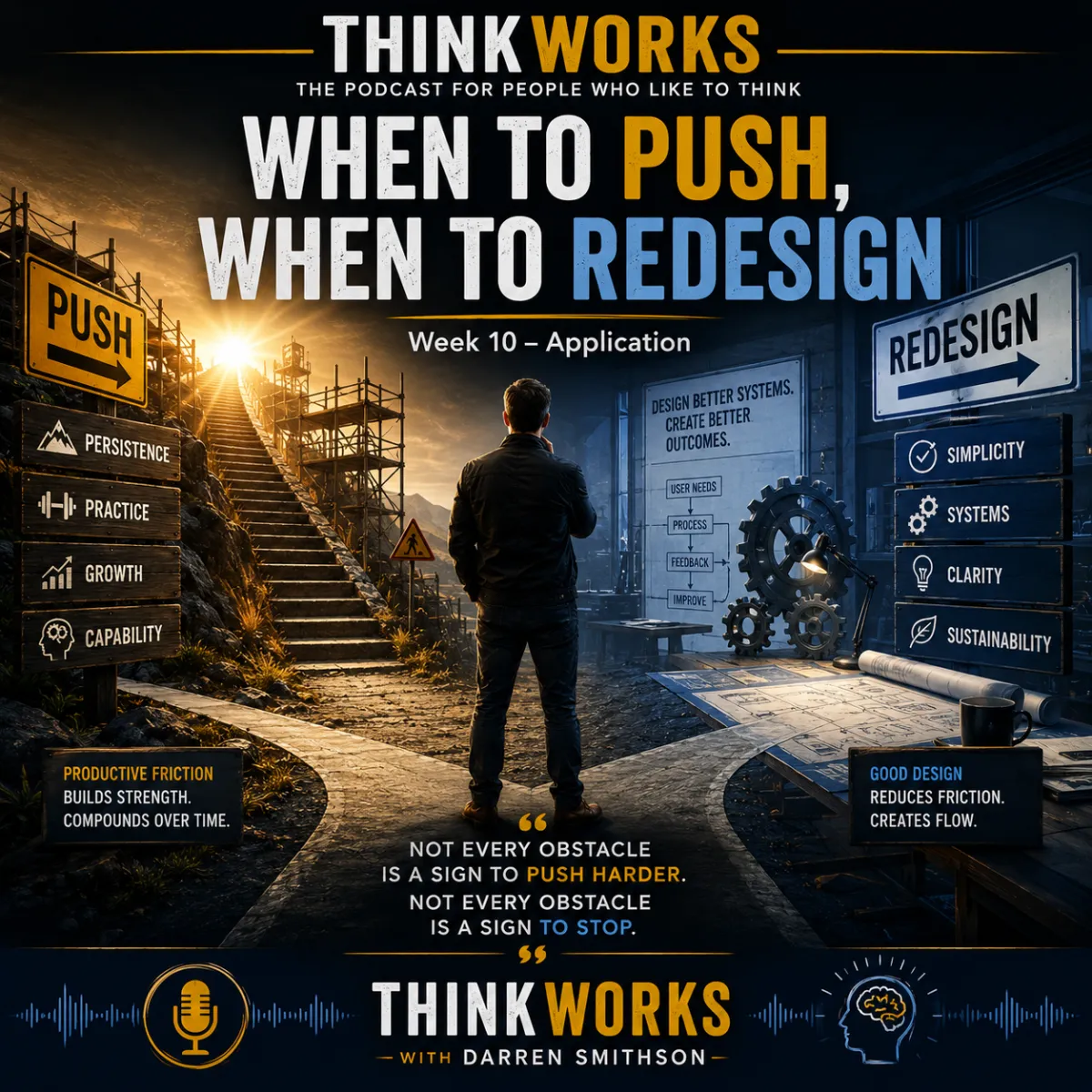
When to Push, When to Redesign
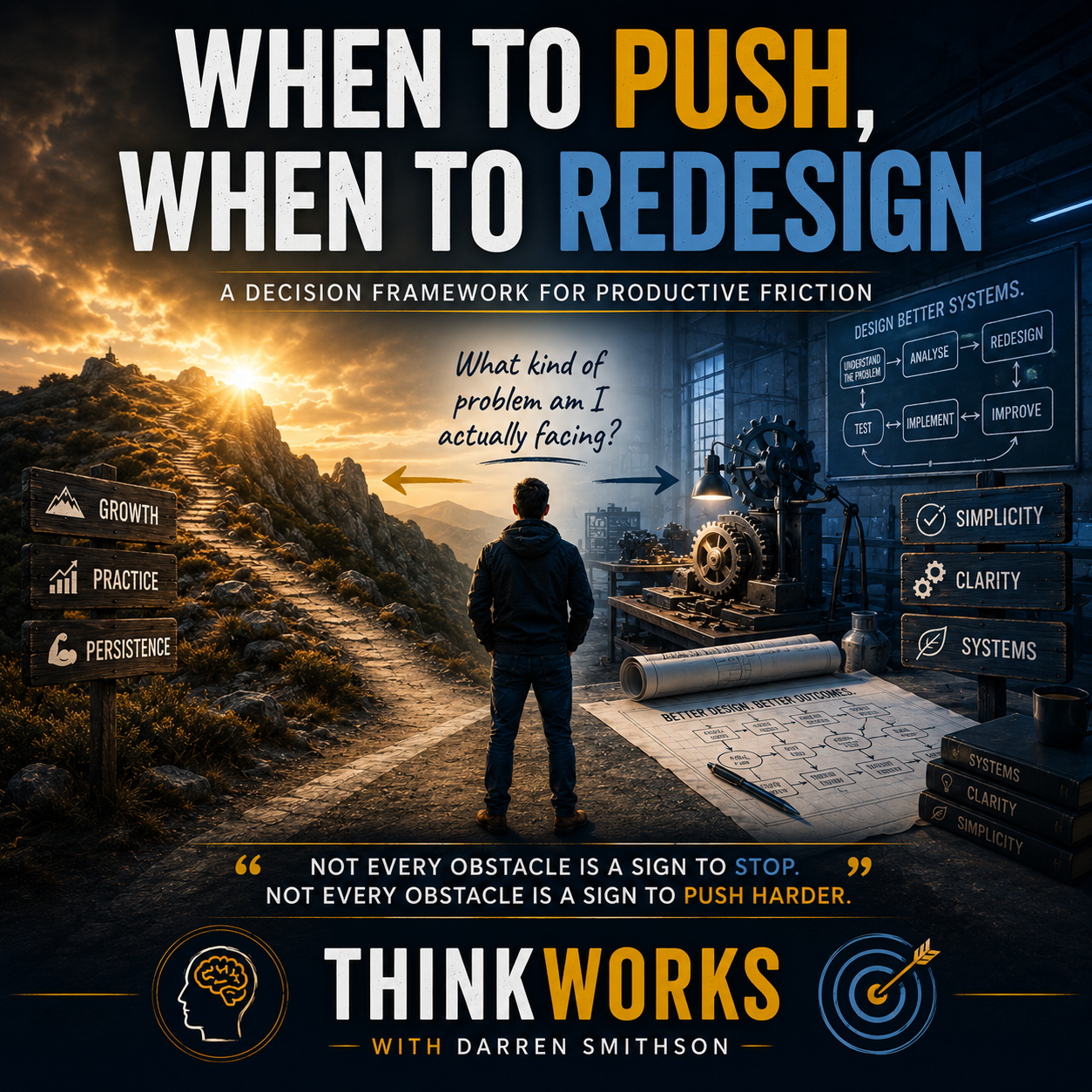
When to Push, When to Redesign
To tie into next week's ThinkWORKS podcast, here's an introduction to the theme being discussed.
One of the most difficult decisions we face in personal growth, business, leadership, and creativity is knowing when to persist and when to change the system itself.
Most advice tends to fall into one of two camps.
The first says:
"Push harder."
Work more.
Try harder.
Be more disciplined.
Keep going.
The second says:
"Find a better way."
Change the process.
Redesign the system.
Work smarter.
Start again.
The problem is that both pieces of advice are sometimes right.
And both are sometimes wrong.
Push when you should redesign and you risk frustration, burnout, and wasted effort.
Redesign when you should push and you may never stay with anything long enough to benefit from the growth it creates.
The real skill is learning the difference.
The Push or Redesign Framework
When you encounter resistance, ask yourself three questions.
1. Is This Creating Growth or Just Creating Pain?
Not all friction is bad.
Learning a new skill is difficult.
Writing a book is difficult.
Changing long-held habits is difficult.
That's productive friction.
It stretches your capabilities and develops new ones.
But some friction creates nothing except exhaustion.
Pointless bureaucracy.
Broken processes.
Repeated obstacles that add no value.
One helps you grow.
The other simply drains your energy.
The first question is:
What is this difficulty producing?
2. Is The System Supporting Success?
Good systems help people succeed.
Bad systems rely on people compensating for their weaknesses.
If success requires heroic effort every single day, that's often a warning sign.
A healthy system should make good performance easier, not harder.
Ask yourself:
Is the system helping me succeed, or am I constantly rescuing it?
3. What Happens If I Continue For Six Months?
This is one of my favourite questions because it forces us to think beyond the immediate moment.
Imagine doing exactly what you're doing now for the next six months.
What happens?
Do you become more capable?
More skilled?
More confident?
Or do you become more frustrated?
More exhausted?
More disengaged?
The answer often reveals whether you're looking at productive friction or poor design.
Why This Matters
Many people treat every obstacle the same way.
Some automatically push harder.
Others automatically change direction.
Neither approach is particularly effective.
Mature thinking requires discernment.
It requires stepping back and asking:
What kind of problem am I actually facing?
Because different problems require different responses.
Some need resilience.
Some need patience.
Some need courage.
And some need redesign.
Reality Check
Not every obstacle is a sign to stop.
But not every obstacle is a sign to push harder either.
The goal isn't to remove every challenge from your life.
The goal is to recognise which challenges are helping you grow—and which ones are asking you to build a better system.
