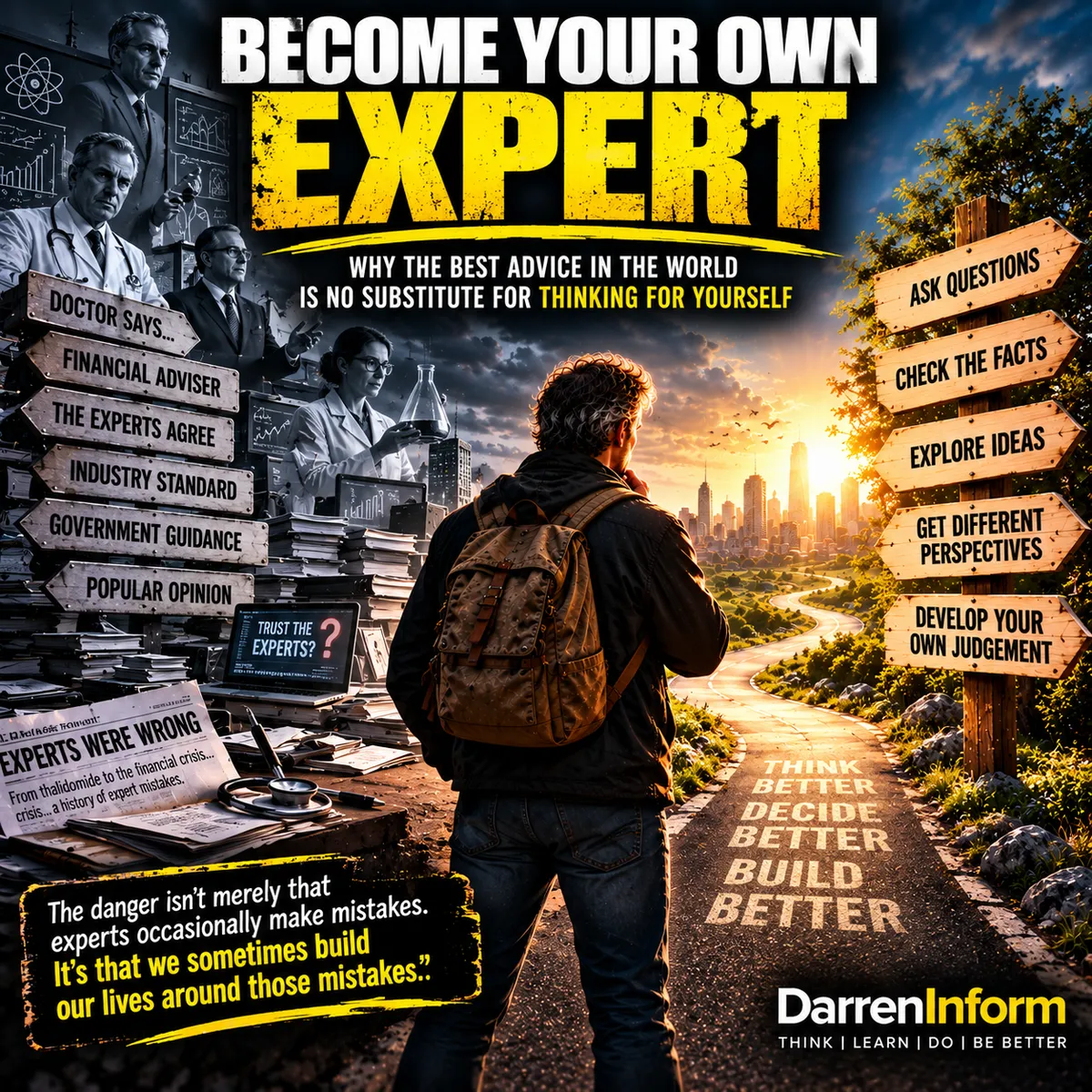
Become Your Own Expert
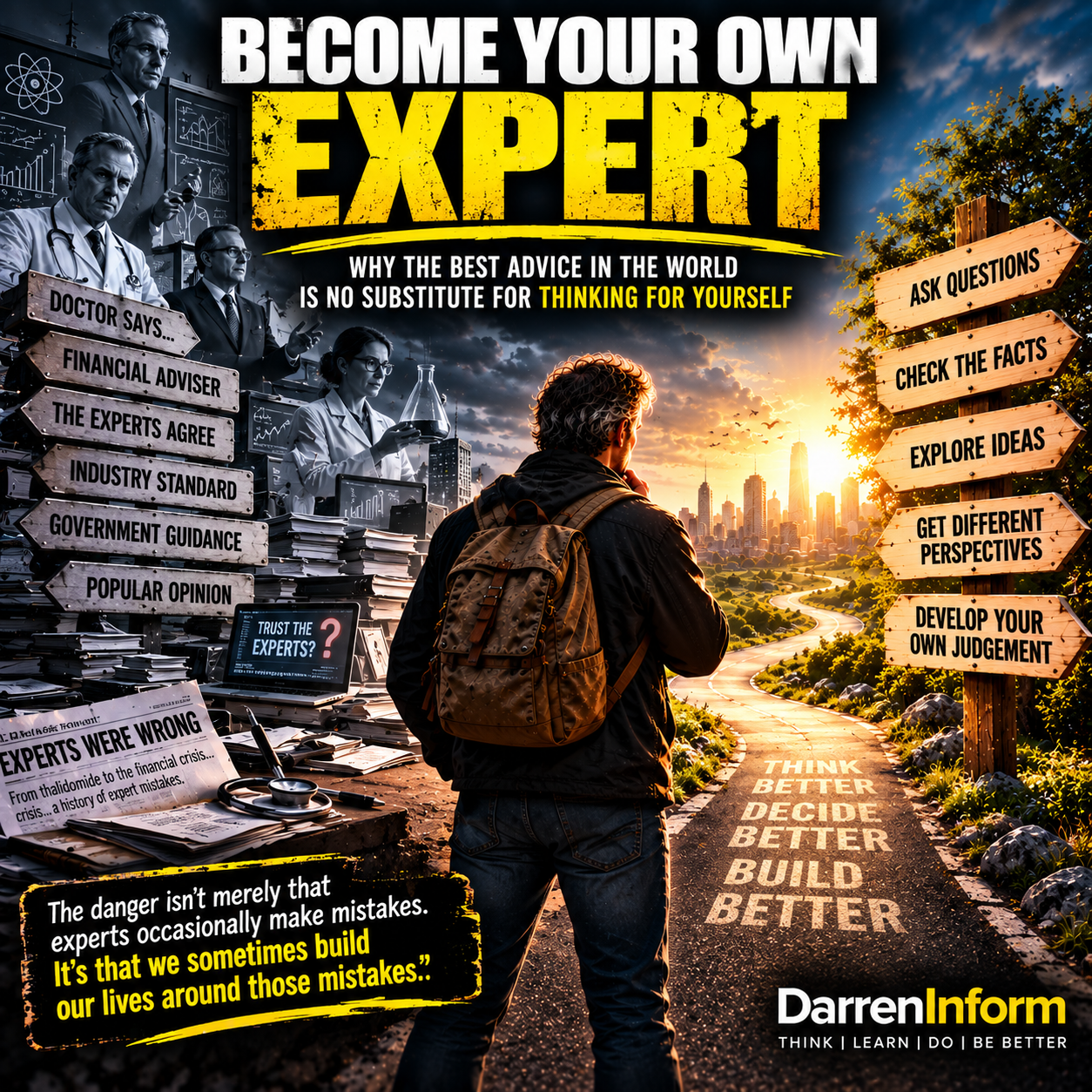
Become Your Own Expert
Why the Best Advice in the World Is No Substitute for Thinking for Yourself
A second opinion isn't always enough.
Whenever we face an important decision, our natural instinct is to seek advice.
We ask somebody who knows more than we do.
An expert.
A professional.
A consultant.
Somebody with qualifications, experience or a reputation for knowing what they're talking about.
And that's generally a sensible thing to do.
After all, expertise matters. We wouldn't have modern medicine, advanced technology or much of the world we take for granted without people who have dedicated years to developing specialist knowledge.
But there's a problem.
Experts can be wrong.
And sometimes the consequences of accepting their opinions without question can shape the rest of our lives.
I know.
Because it happened to me.
The Expert Who Nearly Defined My Future
When I was at school, my mathematics teacher told me I was rubbish at maths.
Not particularly encouraging, I grant you.
But he went further.
He told me I'd never amount to much in any career requiring numerical skills.
And I believed him.
Why wouldn't I?
He was the mathematics teacher.
He was the expert.
I was the pupil.
And so I accepted his judgement.
I struggled with mathematics throughout the rest of my school years, eventually taking three attempts to pass my O Level.
More importantly, I began making decisions about my future based on the assumption that I simply wasn't any good with numbers.
Think about that for a moment.
One person's assessment became part of my identity.
And that identity began shaping my choices.
Not because I'd carefully examined the evidence.
Not because I'd explored my abilities.
But because somebody in a position of authority had told me what I was capable of.
And I'd believed him.
Then Something Rather Strange Happened
After I'd been working for a few years, I discovered something interesting.
I had a knack for understanding technology.
Not just how something worked, but what it might make possible.
I could examine a new technology, understand its potential and explain the benefits to people who didn't necessarily have a technical background.
My employers began using me to demonstrate technological solutions to clients.
I became, somewhat ironically, an acknowledged expert.
And much of the technology I was explaining involved numbers.
Bits.
Bytes.
Processing speeds.
Capacities.
Performance.
I was using numerical information to develop explanations and make recommendations.
Which was rather odd for somebody who supposedly couldn't do maths.
Then I began exploring scientific ideas.
Physics.
Relativity.
The principles behind some of the more extraordinary discoveries about how our universe works.
Eventually, I enrolled on a science degree with the Open University.
And something remarkable happened.
With good teaching materials and explanations that actually made sense to me, I discovered that I wasn't rubbish at mathematics after all.
I could do it.
I could understand it.
I could apply it.
The problem hadn't necessarily been my ability.
The problem had been the way my ability was assessed and developed.
And by then, I'd already made years of decisions based on somebody else's mistaken judgement.
That's a powerful lesson.
Because the opinions we accept about ourselves can become the limitations we impose upon ourselves.
Expertise Isn't Infallibility
Now, before anybody accuses me of declaring war on experts, let me be clear.
I'm not suggesting we should ignore expertise.
Quite the opposite.
Expert knowledge is extraordinarily valuable.
If I'm facing a serious medical decision, I want qualified medical professionals involved.
If I'm building a bridge, I'd rather have an experienced engineer designing it than somebody who watched three videos online.
And if I'm flying somewhere, I definitely want somebody in the cockpit who knows what all those buttons do.
But expertise doesn't make somebody incapable of error.
Experts work with evidence.
They interpret information.
They apply experience.
They make judgements.
And sometimes those judgements turn out to be wrong.
That's not necessarily a failure of expertise.
It's part of being human.
The danger comes when we treat an expert's opinion as something that cannot be questioned.
Because respecting expertise and surrendering your judgement are two very different things.
The Difference Between Advice and Authority
Here's something worth considering.
When somebody gives you advice, what are they actually offering?
They're offering their interpretation of a situation.
Hopefully, that interpretation is informed by knowledge, experience and evidence.
But it may also be influenced by their assumptions, professional background, incentives and understanding of your circumstances.
A financial adviser may approach a problem differently from an entrepreneur.
An engineer may see a different solution from a designer.
A manager may interpret a workplace problem differently from the employees experiencing it.
None of those perspectives is automatically worthless.
And none is automatically complete.
This is why getting a second opinion can be valuable.
But even two experts agreeing doesn't necessarily mean you've explored every relevant consideration.
The question isn't simply:
“Who should I believe?”
It's also:
“What evidence supports this advice, what assumptions does it depend upon, and how well does it apply to my circumstances?”
That's where becoming your own expert begins.
Becoming Your Own Expert Doesn't Mean Knowing Everything
Let's clear up a potential misunderstanding.
I'm not suggesting that you can become a qualified surgeon by reading a few articles.
Or a professional accountant by watching an afternoon's worth of tutorials.
Or an expert physicist because you've had an interesting conversation with an AI.
Specialist knowledge takes time, training and experience.
But there's an important difference between becoming an expert in a profession and becoming sufficiently informed to participate intelligently in decisions affecting your life.
Suppose you're considering a significant medical treatment.
You don't need to become a doctor.
But you can learn about the condition, understand the proposed treatment, ask about its risks and benefits, and explore whether reasonable alternatives exist.
You can ask questions.
You can seek another qualified opinion when appropriate.
And you can make sure you understand the decision rather than simply nodding along.
The same principle applies to business.
You don't need to become an accountant to understand your company's finances.
You don't need to become a software developer to ask sensible questions about a new technology system.
And you don't need to become a marketing specialist to understand what you're paying an agency to achieve.
You don't have to know everything. But you should understand enough to know what you're agreeing to.
That's the distinction.
When Experts Disagree
Of course, there's another complication.
Experts frequently disagree.
Just look at debates about economics, nutrition, education, management or emerging technologies.
You'll find qualified people reaching different conclusions.
Sometimes that's because the evidence is incomplete.
Sometimes they're examining different aspects of the same problem.
Sometimes their assumptions differ.
And sometimes one of them is simply mistaken.
But disagreement doesn't automatically mean expertise is worthless.
It means we need to understand the nature of the disagreement.
What do the experts agree on?
Where does the evidence become uncertain?
Which conclusions are strongly supported?
Which depend on assumptions?
And what new information might change the picture?
These are far more useful questions than simply deciding which expert sounds most convincing.
And they're particularly important now.
Because artificial intelligence has made access to information easier than ever.
We can ask an AI system to explain a complicated subject, compare competing arguments or help us formulate questions.
That's an extraordinary opportunity.
But AI-generated explanations can also contain errors, omissions and misplaced confidence.
A polished answer isn't necessarily a correct answer.
So the same principle applies.
Use the tools. Consult the expertise. Examine the evidence. But don't outsource your judgement.
The Problem With Blind Trust
One of the examples I explore in You 2.0 concerns investment decisions.
Even Warren Buffett, one of the most successful investors in history, has made costly mistakes.
In 2008, he invested heavily in ConocoPhillips, anticipating favourable developments in energy markets.
Unfortunately, he bought at a price that proved far too high.
He subsequently acknowledged the mistake.
Now, Buffett's error doesn't mean he isn't an extraordinary investor.
It means even extraordinary investors can get things wrong.
And if you're making decisions simply because somebody successful has made the same decision, you may be accepting risks you don't fully understand.
There's another important lesson here.
A good decision isn't simply one made by somebody with a good track record.
It's one that has been examined in the context of the evidence, risks and circumstances involved.
That doesn't guarantee success.
Nothing does.
But it gives you a much better foundation for making an informed choice.
The Other Danger: Analysis Paralysis
Now, there's a trap waiting for us on the other side of this argument.
If we shouldn't blindly accept the first opinion we hear, should we keep researching until we're absolutely certain?
No.
Because absolute certainty is rarely available.
And endless research can become another way of avoiding responsibility for making a decision.
You seek one opinion.
Then another.
Then another.
You read articles.
Watch videos.
Compare arguments.
Ask AI.
Ask colleagues.
Ask friends.
And eventually find yourself with seventeen competing recommendations and absolutely no idea what to do.
Congratulations.
You've discovered analysis paralysis.
And I've got news for you.
Not making a decision is often a decision in itself.
Opportunities disappear.
Problems become worse.
Circumstances change.
Other people make decisions that affect you.
So becoming your own expert isn't about researching forever.
It's about developing sufficient understanding to make a reasonable decision.
Then making it.
And accepting that you may need to adjust course later.
A Better Way to Make Decisions
Here's a practical approach I've developed from the thinking in You 2.0.
When you're facing an important decision, work through five questions.
1. What am I actually trying to achieve?
Start with the outcome.
Not the advice.
Not the proposed solution.
What problem are you trying to solve?
What opportunity are you trying to pursue?
What would a successful result look like?
2. What do I already know — and what am I assuming?
Separate established facts from opinions and assumptions.
Be particularly careful with beliefs you've held for years.
Some of them may have originated with somebody else's judgement rather than your own experience.
3. Whose expertise is genuinely relevant?
Seek advice from people with appropriate knowledge and experience.
But remember that expertise is often specialised.
Somebody can be exceptionally knowledgeable in one area without being equally qualified to advise on everything connected to it.
4. What evidence would make me reconsider?
This is an important one.
If you're already convinced you know the answer, you may simply seek information that confirms your existing opinion.
Ask what would change your mind.
And be prepared to encounter it.
5. When will I decide?
Set yourself a reasonable deadline.
The more significant the decision, the more care it deserves.
But don't confuse careful thinking with endless hesitation.
Eventually, you have to act.
And if new evidence emerges, you can reconsider.
That's not failure.
That's learning.
The Expert You Should Never Ignore
There's one final point I want to make.
And it brings us back to my old mathematics teacher.
Sometimes the most damaging expert opinions aren't about the economy, technology or business.
They're about us.
Our abilities.
Our intelligence.
Our potential.
What we should do.
What we're supposedly incapable of doing.
Perhaps somebody once told you that you weren't creative.
That you weren't leadership material.
That you couldn't run a business.
That you weren't academic.
That you weren't good with people.
Or that a particular ambition simply wasn't realistic.
And perhaps you've carried that judgement around for years.
But here's the question.
Was it a fact — or somebody else's interpretation of who you were at that moment?
Because those are very different things.
And the person who made that judgement may have been working with incomplete information.
They may have misunderstood your abilities.
They may have failed to recognise your potential.
Or they may simply have been wrong.
Just as my mathematics teacher was wrong about me.
The danger isn't merely that experts occasionally make mistakes.
It's that we sometimes build our lives around those mistakes.
Think Better. Decide Better. Build Better.
So here's my challenge to you.
Think about an important decision you're facing.
Or perhaps a belief about yourself that you've accepted for years.
Ask yourself:
Where did this belief come from?
What evidence actually supports it?
Have I examined it for myself?
And what might become possible if it turned out to be wrong?
Don't reject good advice simply because it comes from an expert.
But don't accept it blindly because somebody has qualifications, authority or a convincing reputation.
Learn.
Question.
Compare.
Understand.
Then make your own informed decisions.
Because becoming your own expert isn't about knowing more than everybody else.
It's about taking greater responsibility for understanding the decisions that shape your life.
And sometimes, the first step towards building yourself better is recognising that somebody else's opinion was never the final word on what you could become.
Respect expertise. Question assumptions. Own your decisions.
That's how you begin to become your own expert.
Adapted from Lesson 2, “Become Your Own Expert!”, in You 2.0: Build Yourself Better.
