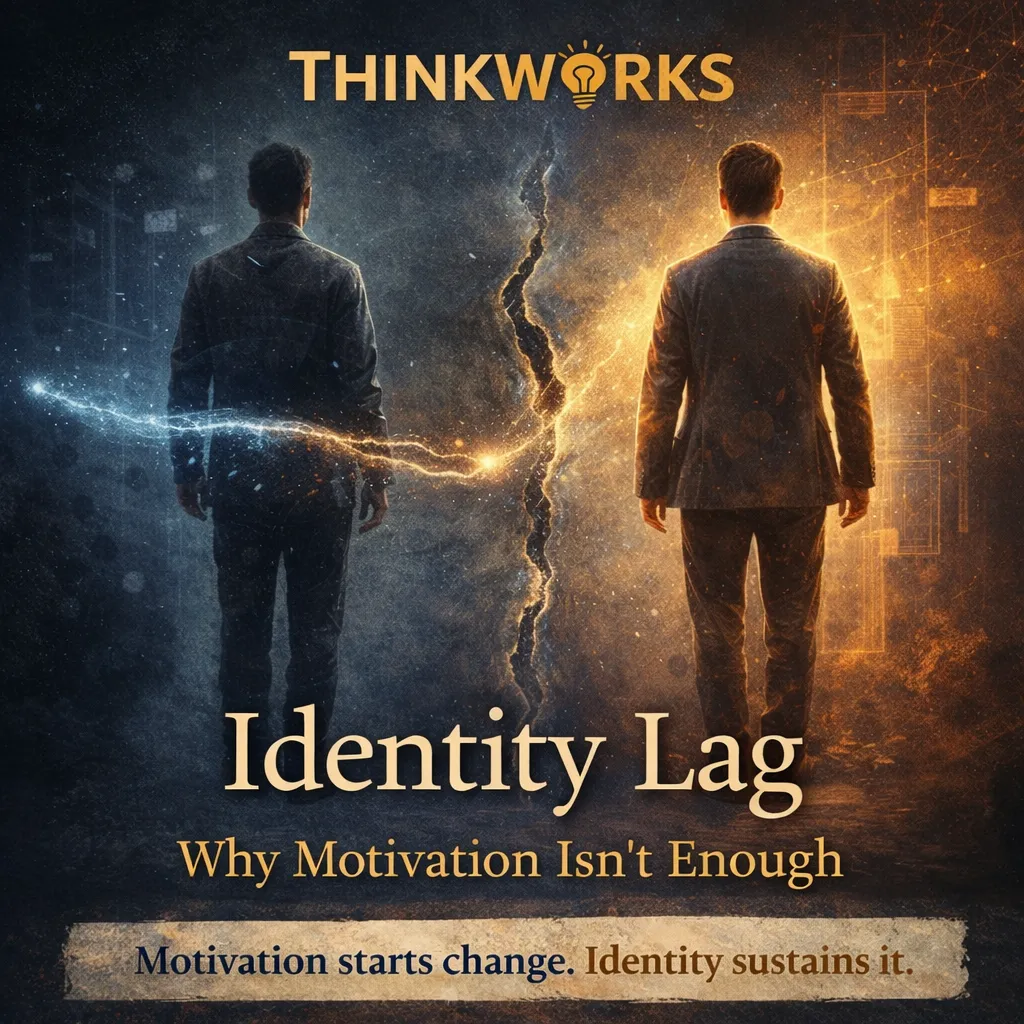
Why Motivation Can’t Survive Identity Lag
🧠 THINKWORKS
Why Motivation Can’t Survive Identity Lag
There’s a moment most people recognise.
You decide something is going to change.
You’re clear.
You’re focused.
You’re motivated.
This time feels different.
And for a while… it works.
You take action.
You show up.
You move forward.
And then, slowly…
Something shifts.
Not dramatically.
Not all at once.
But enough.
The consistency fades.
The energy drops.
The old patterns creep back in.
And the usual explanation is simple:
“I just lost motivation.”
But that’s not actually what’s happening.
The Problem Isn’t Motivation
Motivation didn’t fail you.
It did exactly what it’s supposed to do.
It started something.
The real issue is what happens after that.
Because motivation is not designed to sustain change.
It’s designed to trigger it.
What determines whether change lasts is something deeper.
Something quieter.
Something most people never notice.
👉 Identity lag
What Is Identity Lag?
Identity lag is the gap between:
who you are right now
andwho you’re trying to become
And that gap matters more than most people realise.
Because when you try to change your life…
You’re not just changing behaviour.
You’re stepping into a version of yourself that doesn’t fully exist yet.
For a while, motivation bridges that gap.
It carries you forward.
But it can’t hold it.
Because eventually…
Your behaviour starts to drift back toward what feels normal.
Not your intentions.
Not your goals.
👉 Your identity.
Why Change Breaks Down
This is where most people get it wrong.
They assume the problem is:
lack of discipline
lack of consistency
lack of effort
So they push harder.
Try to optimise more.
Build better routines.
But the issue isn’t effort.
It’s alignment.
If your behaviour is operating ahead of your identity…
There will be friction.
And over time…
That friction wins.
You Don’t Rise to Intentions
One of the core ideas in You 2.0 is this:
You don’t rise to your intentions — you operate from your internal structure.
And identity is part of that structure.
It’s not just what you say you are.
It’s what feels:
normal
sustainable
familiar
So if you try to:
be more disciplined
be more focused
be more consistent
…but that doesn’t yet feel like you…
You’re effectively trying to run a system your structure can’t support.
The Mistake: Fighting the Friction
This is where people fall into the trap.
They experience resistance and think:
“I need more willpower”
“I need to push harder”
“I need to fix what’s wrong with me”
So they treat the resistance as the enemy.
But it isn’t.
👉 It’s information.
It’s showing you the gap between:
your current identity
andyour intended one
If you try to fight that signal…
You exhaust yourself.
Not improve yourself.
The Einstein Principle: Stop Over-Optimising
There’s another layer here.
And it shows up everywhere.
People try to optimise too early.
They build:
perfect routines
complex systems
strict rules
Before they’ve stabilised the basics.
This is what I call the Einstein Principle:
👉 Don’t try to operate at a high level before the foundation is stable.
Because when your system only works under ideal conditions…
It will fail under real ones.
And when it fails…
You don’t question the system.
You question yourself.
Why Motivation Always Feels Temporary
Now the pattern becomes clear.
Motivation creates a surge.
That surge drives behaviour.
But if identity hasn’t caught up…
The system can’t hold.
So things drift.
Not instantly.
But enough.
And that’s why motivation feels unreliable.
Because it is.
👉 It was never meant to be the foundation.
Rethinking Discipline
This is where discipline needs reframing.
It’s often described as:
“Doing things you don’t feel like doing.”
And that’s partly true.
But it’s incomplete.
Because real discipline isn’t just forcing behaviour.
It’s aligning behaviour with something that can sustain it.
If your system is fighting your identity…
Discipline feels exhausting.
If your system fits your identity…
Discipline becomes quieter.
More consistent.
Less dramatic.
What To Do Instead
So what actually works?
Three simple shifts.
1. Expect the Lag
When you change direction…
Things will feel unnatural.
That’s not failure.
That’s transition.
2. Stabilise Before You Optimise
Don’t build the perfect system.
Build a repeatable one.
Something you can do:
on a good day
and on a bad day
Consistency beats complexity.
3. Shift Identity Through Evidence
Identity doesn’t change through intention.
It changes through repetition.
Small actions.
Repeated often enough…
That they start to feel normal.
The Real Question
So next time you think:
“I just need more motivation…”
Pause.
And ask something better:
👉 “Am I trying to operate ahead of my current identity?”
Because if you are…
The solution isn’t more effort.
It’s:
better alignment
more patience
and a system that fits where you are
Not just where you want to be.
Final Thought
Motivation starts change.
But identity sustains it.
And once you understand the gap between the two…
You stop fighting yourself.
And start building something that actually lasts.
