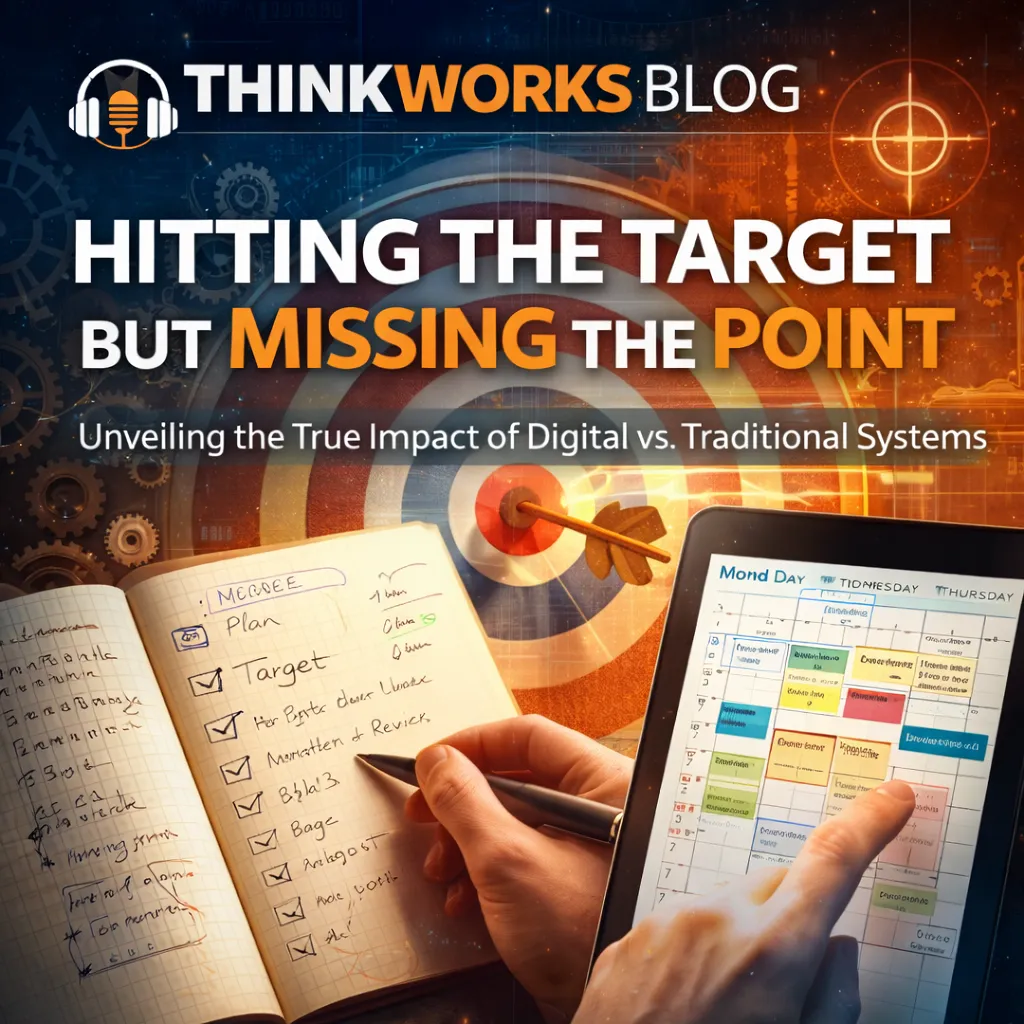
Hitting the Target but Missing the Point
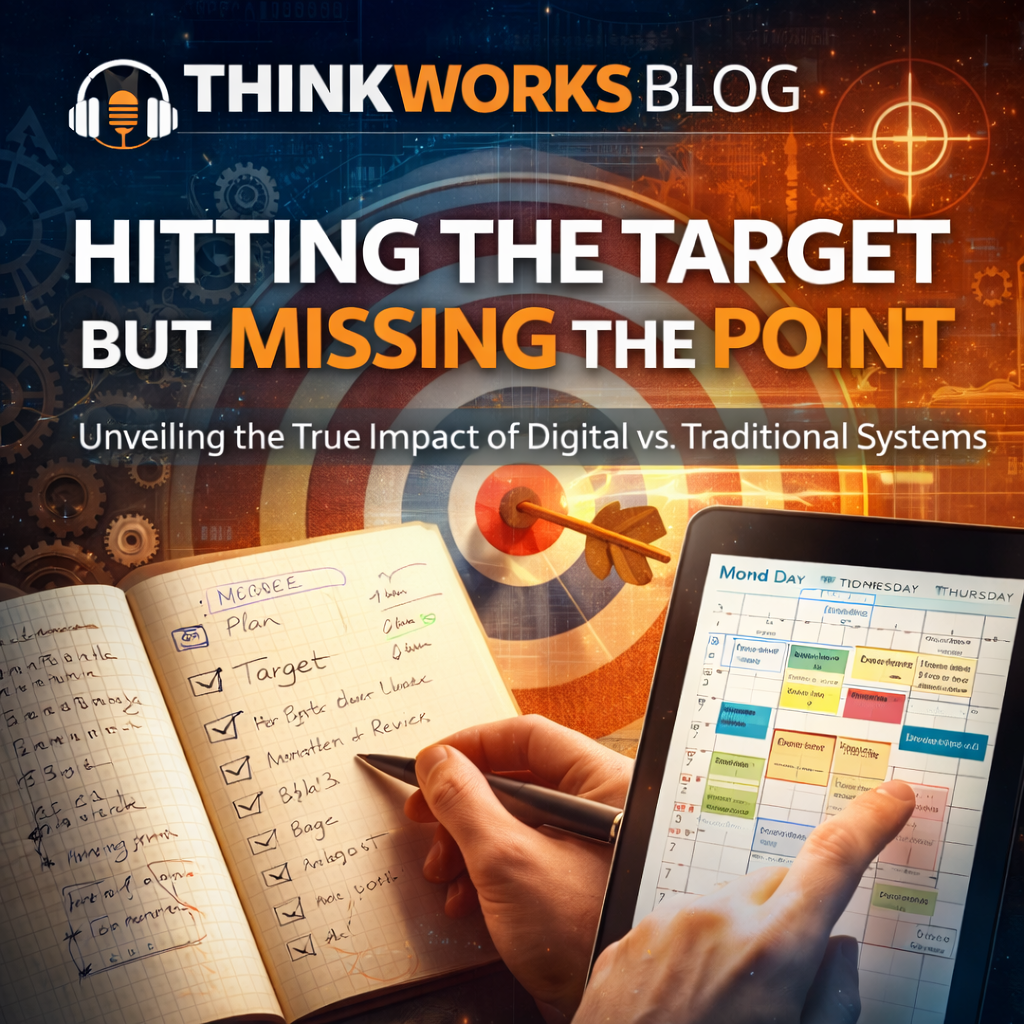
Hitting the Target but Missing the Point
The Real Impact of Digital vs Traditional Systems
Over the past few years I’ve experimented with almost every planning system under the sun.
Digital planners.
Apps.
Project management tools.
Calendars with more features than a space shuttle.
And yet, despite all that technological power, I still keep coming back to something very simple:
Paper and pen.
For a long time I used Tony Robbins’ RPM planning system in a physical planner, and there was something about the experience that digital tools have never quite managed to replicate.
It wasn’t nostalgia.
It wasn’t resistance to technology.
It was something deeper.
The act of writing, planning and thinking on paper creates a different relationship with ideas than typing them into a screen.
And interestingly, the research backs this up.
The Value of Paper and Pen
Handwriting isn’t just a method of recording information. It’s a cognitive process.
When you write something down, you’re engaging multiple parts of the brain at once: language processing, motor skills, memory formation and conceptual thinking.
In other words, writing forces you to think differently.
A study published in the Journal of Educational Psychology found that students who take notes by hand tend to retain information better than those who type notes on a laptop. The reason is simple: typing often becomes transcription, whereas handwriting forces you to process and summarise information.
Another study published in Psychological Science found that handwriting activates brain regions linked to thinking, working memory and language processing. The physical act of forming letters strengthens the cognitive link between the idea and the memory.
There’s also the tactile element.
Research in the British Journal of Educational Technology highlights the importance of tactile feedback in learning. The sensation of pen on paper creates a multisensory experience that helps anchor ideas more effectively than purely digital interaction.
Then there’s flexibility.
A paper planner lets you sketch diagrams, draw arrows between ideas, scribble notes in margins or redesign your layout on the fly. Digital tools, by contrast, tend to impose a structure first and ask you to adapt your thinking to fit inside it.
Interestingly, a project management case study found that teams using paper-based planning systems reported higher satisfaction and fewer scheduling errors. One reason cited was the simple ability to flip through pages quickly and see the flow of information visually.
None of this means digital tools are bad.
But it does highlight something important.
Sometimes the simplest tools remain powerful because they align better with how humans naturally think.
The Challenges of Digital Planning Tools
Now let’s be fair.
Digital systems bring enormous advantages.
They’re portable, searchable, synchronised and accessible from anywhere in the world.
But they also introduce new challenges.
A study in the International Journal of Project Management found that digital scheduling tools can increase planning errors when the interface is overly complex or unintuitive. Project managers reported that important details were often buried under layers of menus, notifications and settings.
Another issue is cognitive load.
Research in the Journal of Human-Computer Interaction shows that poorly designed digital interfaces increase mental effort. Instead of helping users think more clearly, the software forces them to spend energy navigating the system itself.
Then there’s the subtle issue of over-reliance.
Studies published in the Journal of Organizational Behavior suggest that when people rely heavily on digital reminders, they become less engaged in proactive planning. The system starts thinking for them.
This can create a strange paradox.
The tool designed to make us more organised can sometimes make us less intentional.
And many organisations discover another challenge: integration.
Research from the Journal of Information Technology shows that digital systems often struggle to communicate with each other. Different tools store information in different ways, creating compatibility issues and data silos that actually slow down collaboration.
So while digital systems promise efficiency, they often introduce complexity.
When Digital Systems Miss the Point
Sometimes the problem isn’t technology itself.
It’s how the system has been designed.
Take the UK prescription system as an example.
Many patients are required to order prescriptions online within a five-day window before the medication is due. On paper that sounds efficient.
In reality, the system often fails to account for weekends, holidays or pharmacy processing times.
The result?
Patients experience delays, anxiety and sometimes missed doses.
A discussion in the British Medical Journal highlights how systems like this can unintentionally create new problems when they prioritise administrative efficiency over real user experience.
Research in the Journal of Health Informatics points to a common pattern in digital systems: they’re often designed without sufficient input from the people who actually use them day to day.
And when that happens, the system may hit its technical targets…
…but still miss the real-world point.
Studies in the Journal of Public Health have also shown that poor user experience in digital health systems can lead to reduced compliance and worse outcomes.
The lesson here is simple.
Technology doesn’t fail because it lacks capability.
It fails because it lacks human-centred design.
Why Digital Projects Often Fail
This issue extends far beyond healthcare.
A study published in the Project Management Journal found that around 70% of digital projects fail to achieve their intended goals.
Not because the technology doesn’t work.
But because the human system around it does.
Common problems include:
unclear project objectives
insufficient stakeholder involvement
poor integration with existing systems
weak risk management
lack of user training
ignoring organisational culture
Research in the International Journal of Human-Computer Studies highlights that projects built with user involvement from the beginning are far more likely to succeed.
In other words:
The best digital systems are designed with people, not just for them.
Successful digital transformation isn’t about replacing humans with software.
It’s about designing systems that genuinely support how people work.
The Hybrid Approach
So where does that leave us?
The real answer is not digital versus traditional.
It’s digital plus traditional.
Technology is incredibly powerful when it handles tasks that machines do well:
storing information
synchronising schedules
analysing data
enabling communication
But human thinking still benefits enormously from tools that engage the brain more directly.
Paper planners.
Whiteboards.
Sketching ideas.
Writing thoughts by hand.
The goal isn’t to abandon technology.
It’s to make sure the technology serves the thinking — not the other way around.
A Question Worth Asking
So here’s a simple challenge.
Take a look at the systems you use every day.
Your planners.
Your apps.
Your tools.
Your workflows.
Are they actually helping you think more clearly?
Or are they simply adding another layer of complexity?
Sometimes the smartest move isn’t adding another tool.
It’s returning to something simpler.
Over to You
I’d love to hear your experiences.
Do you rely mainly on digital tools?
Or do you still use paper planners or notebooks?
And more importantly:
What actually works best for you?
Because in the end, productivity isn’t about having the most sophisticated system.
It’s about having the system that helps you think and act more effectively.
