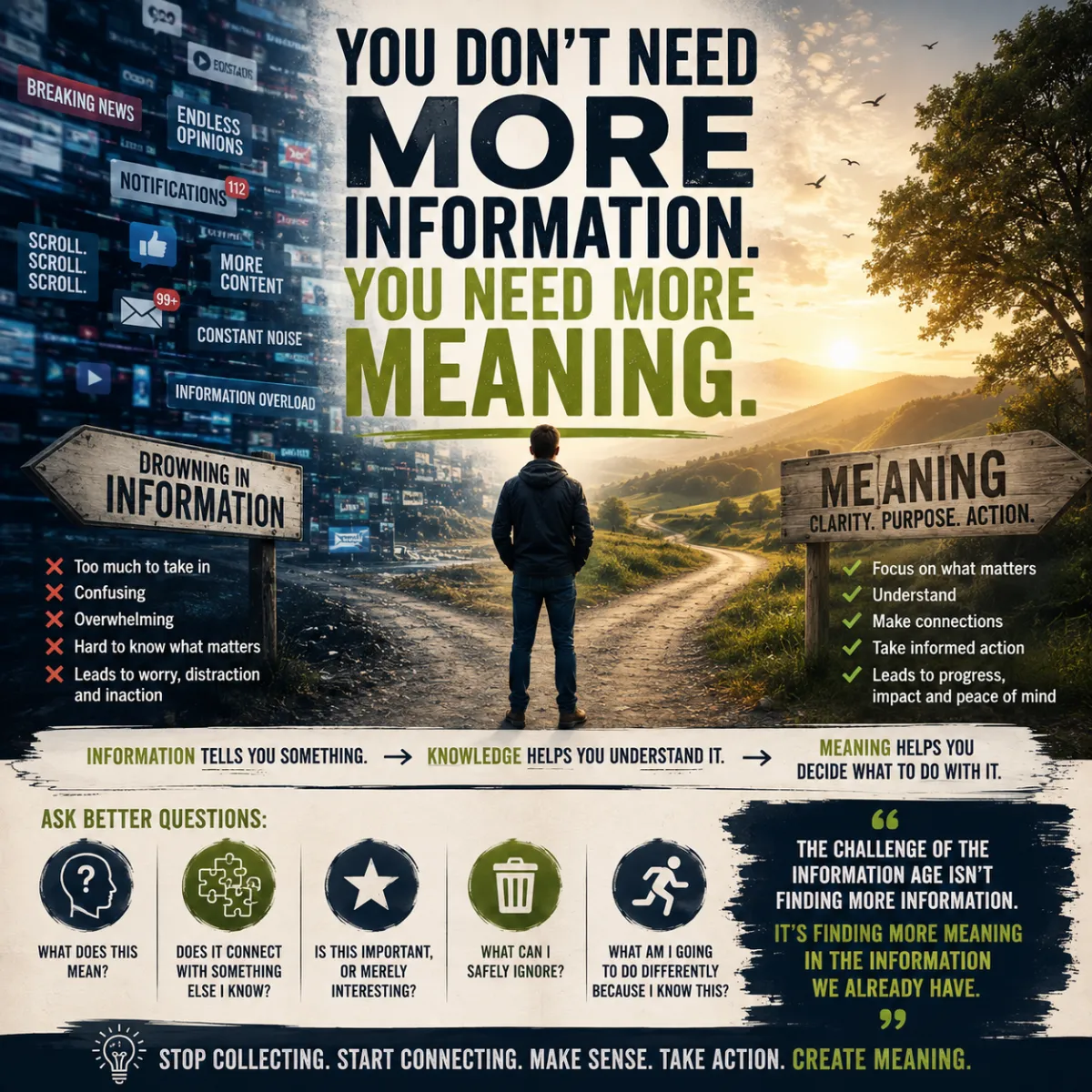
You Don't Need More Information. You Need More Meaning.
You Don't Need More Information. You Need More Meaning.
We live in a world drowning in information, but starving for meaning.
Think about how extraordinary that is.
For most of human history, information was scarce.
If you wanted to learn about something, you needed access to somebody who knew about it. Or a book. Or a library. Or perhaps a university.
Today?
Take a small device out of your pocket and you have access to more information than previous generations could have imagined.
You can search almost any subject.
Read academic papers.
Watch lectures.
Listen to podcasts.
Follow experts.
Subscribe to newsletters.
Take online courses.
Ask AI.
And receive breaking news from the other side of the planet almost as it happens.
We have solved the problem of access to information on a scale that would have seemed miraculous only a few decades ago.
But we've created another problem in its place.
What are we supposed to do with all of it?
When More Stops Helping
There's an assumption buried deep within our information culture:
If I know more, I'll understand better.
Sometimes that's true.
But not always.
There comes a point where another article doesn't provide clarity.
It simply provides another opinion.
Another podcast gives you another perspective.
Another book gives you another framework.
Another social media thread gives you another ten things you're apparently doing wrong.
And eventually you can become extraordinarily well informed...
…and completely unsure what to do.
That's because information and understanding aren't the same thing.
I'd go further.
Information tells you something.
Knowledge helps you understand it.
Meaning helps you decide what to do with it.
And increasingly, I think that final step is where we're struggling.
The Infinite Research Trap
I love learning.
Anyone who follows my work probably knows that already.
But learning has a rather clever disguise it can occasionally wear.
Procrastination.
There's always one more thing you could read before making the decision.
One more video you could watch.
One more expert you could consult.
One more comparison you could make.
One more piece of research that might finally provide certainty.
Except certainty rarely arrives.
So you keep collecting.
You save articles you'll never read.
Bookmark videos you'll never watch.
Buy books that join the increasingly precarious pile beside the bed.
Perhaps you even ask AI to explain the subject again from another angle.
It feels productive because you're doing something.
But eventually learning has to become something else.
Integration.
You have to stop asking:
"What else can I learn?"
And start asking:
"What does what I've already learned mean?"
The Bottleneck Has Moved
This is partly a systems problem.
When information was difficult to obtain, the bottleneck was access.
The challenge was finding enough information to make an informed decision.
That bottleneck has moved.
For many of us today, the problem isn't insufficient input.
It's processing.
We're trying to consume more information than we have the time, attention or mental capacity to properly evaluate.
And our response is often to consume even more.
That's rather like trying to solve a traffic jam by adding more cars.
At some point, you have to stop increasing the input and improve the system processing it.
That means thinking.
Reflecting.
Connecting ideas.
Discarding what doesn't matter.
Testing what does.
And occasionally accepting that you already know enough to take the next step.
Ask a Better Question
So here's something simple to try.
The next time you read an interesting article, finish a book, listen to a podcast or learn something new, don't immediately move on to the next piece of information.
Stop.
And ask:
What does this mean?
Then go a little further.
Does this change anything I previously believed?
Does it connect with something else I know?
Is this actually important, or merely interesting?
What can I safely ignore?
And perhaps most importantly:
What am I going to do differently because I know this?
Sometimes the answer will be:
"Nothing."
And that's fine.
Not every piece of knowledge requires action.
But consciously deciding that something doesn't matter is very different from simply allowing it to disappear beneath the next hundred things demanding your attention.
Information Isn't Wisdom
We're going to need this distinction more and more.
Because the amount of information available to us isn't going to decrease.
AI will generate more.
Social platforms will distribute more.
Businesses will produce more.
News organisations will publish more.
People will comment on more.
The great challenge of the next few years won't be finding information.
It will be filtering it.
Understanding it.
Connecting it.
Questioning it.
And deciding what deserves our limited attention.
That's where judgement becomes increasingly valuable.
Because the person who knows the most isn't necessarily the person who understands the most.
And the person who consumes the most information isn't necessarily the best informed.
Sometimes they're simply the most overwhelmed.
From Information to Meaning
So perhaps we need to become a little less obsessed with collecting knowledge and a little more interested in making sense of it.
Read.
Listen.
Explore.
Stay curious.
Learn constantly.
But occasionally...
stop consuming.
Give your brain some space to work with what you've already put into it.
Ask what connects.
Ask what matters.
Ask what changes.
Ask what you can discard.
And ask what deserves action.
Because the challenge of the information age isn't finding more information.
It's developing the judgement to know what matters, the wisdom to understand what it means, and the courage to act on it.
We aren't starving for information.
We're starving for meaning.
