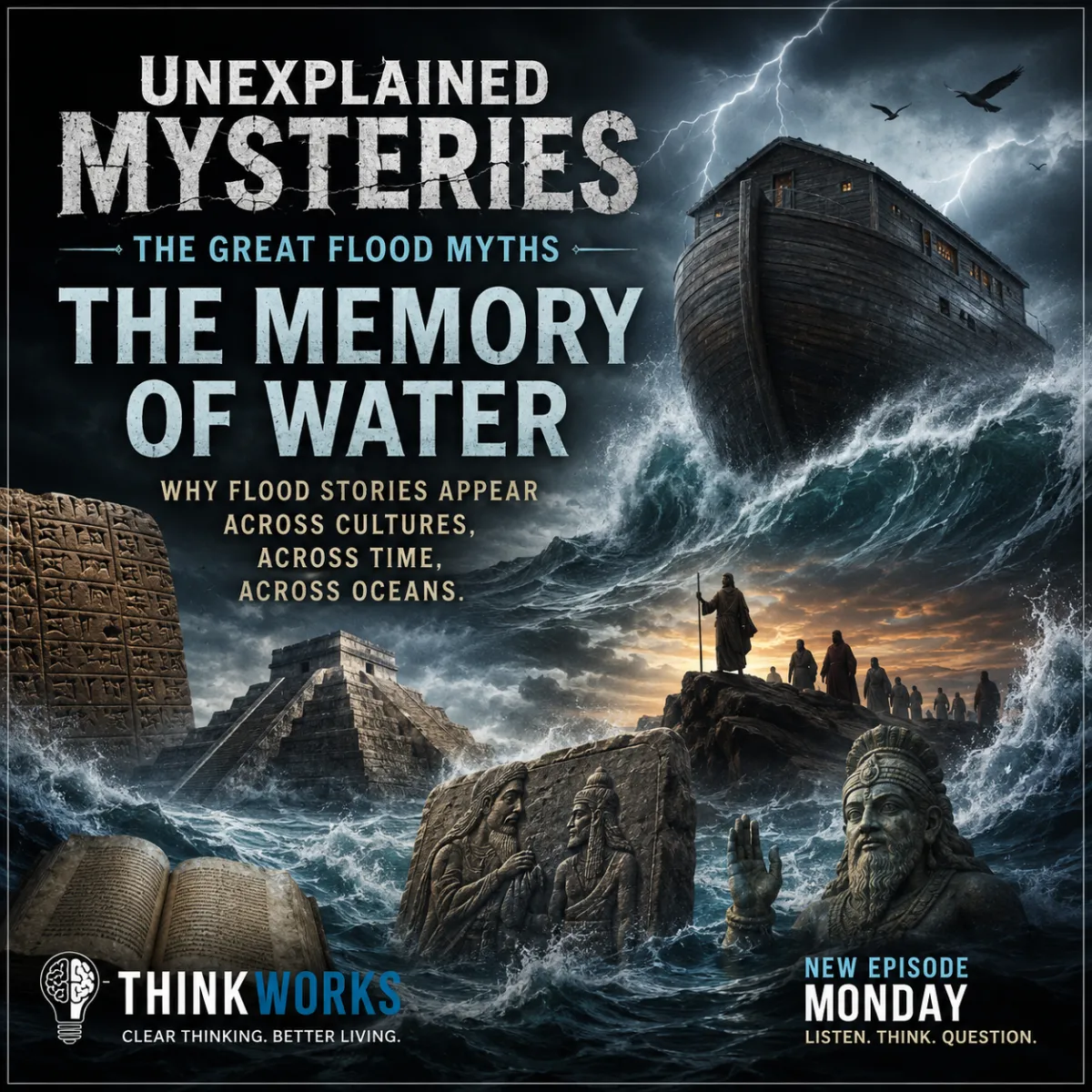
The Memory of Water: Why Great Flood Myths Refuse to Disappear
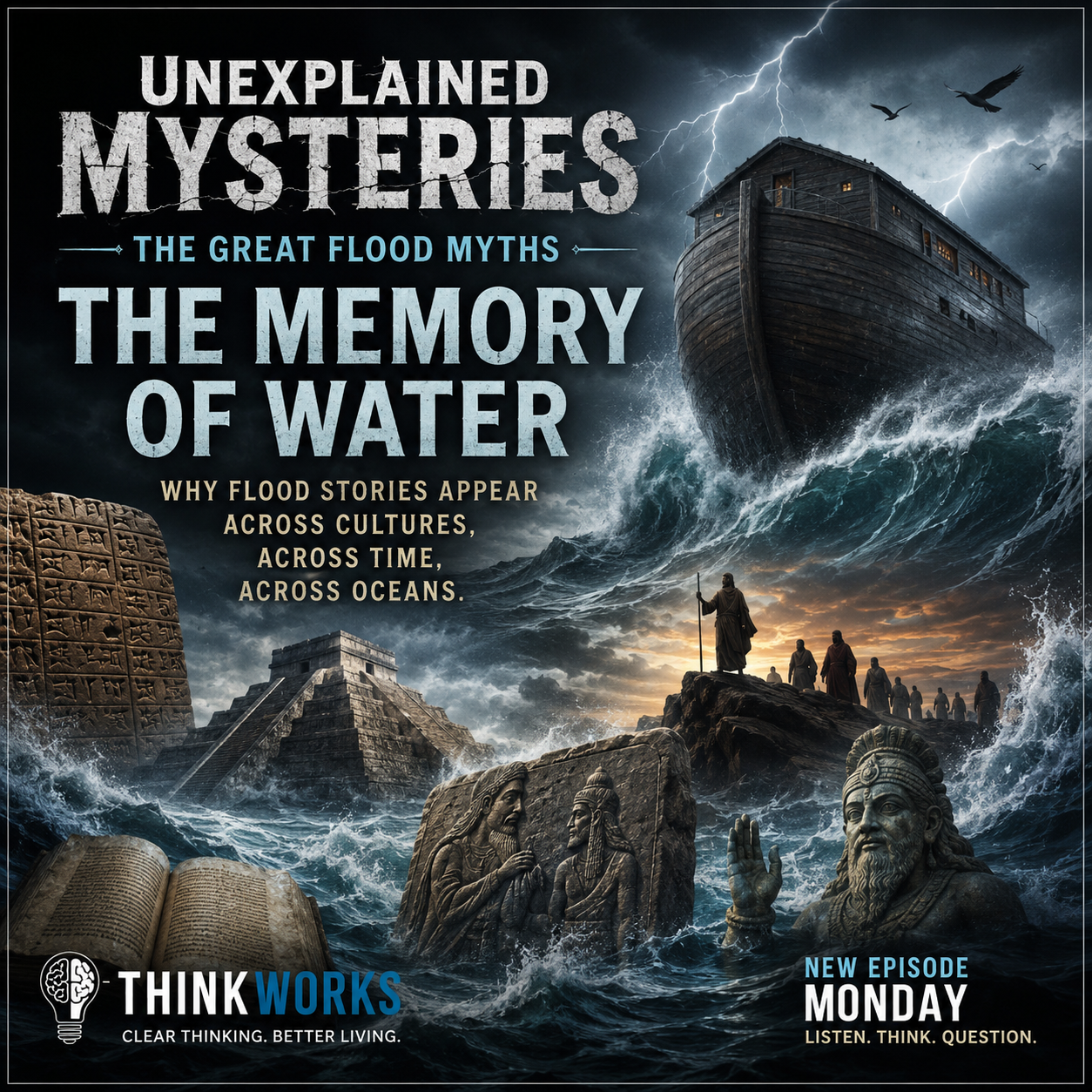
The Memory of Water: Why Great Flood Myths Refuse to Disappear
Some stories seem to belong to everyone.
A world becomes corrupt, careless or dangerously out of balance.
Warnings are ignored.
The waters rise.
Almost everything is lost.
A small group survives—sometimes in a boat, sometimes on a mountain, sometimes through divine intervention—and from the ruins, the world begins again.
Most people in Britain first encounter this pattern through the biblical story of Noah. But Noah is only one survivor among many.
Long before the familiar version was written down, Mesopotamian stories told of a devastating flood and a man instructed to build a vessel. Ancient Greek mythology gave us Deucalion and Pyrrha. Hindu tradition tells of Manu, warned of the coming deluge by a mysterious fish. Flood stories also appear in traditions from the Americas, the Pacific and parts of Africa.
The details differ.
The pattern remains strangely familiar.
And that raises an irresistible question:
Why?
A Single Disaster—or Many Human Memories?
The most dramatic explanation is also the most tempting.
Perhaps all these stories preserve the memory of one enormous prehistoric catastrophe: a flood so vast that survivors carried its story across the world.
It is a powerful idea. It appears to connect mythology, archaeology and lost-history speculation in one elegant sweep.
But elegant explanations are not always accurate ones.
Flooding has been one of humanity’s most persistent dangers. Early civilisations frequently developed beside rivers, lakes and coastlines because water made agriculture, trade and settlement possible.
The same water that sustained a civilisation could also destroy it.
A river overflowing its banks may not cover the entire planet. To the people whose homes, crops and communities disappear beneath it, however, it can feel as though the whole world has ended.
And in a very real sense, their world has.
This may explain why so many cultures developed stories of overwhelming water without requiring every story to originate from the same event.
Different floods.
Different peoples.
The same human terror.
When Disaster Becomes Meaning
But flood myths are rarely simple weather reports.
They do not merely say that it rained heavily or that a river burst its banks. They turn catastrophe into a moral and cosmic drama.
The flood often comes because the old world has gone wrong.
Humanity has become violent, arrogant, noisy, disobedient or corrupt. The established order can no longer continue. Water arrives not only as destruction, but as judgement, cleansing and reset.
That tells us something important about mythology.
Human beings do not like meaningless disaster.
When terrible things happen, we search for causes. We ask why warning signs were missed, who was responsible, whether the disaster could have been avoided and what lessons must be carried forward.
Myths transform chaos into a story.
A flood becomes more than water. It becomes a warning.
The survivor becomes more than fortunate. They become chosen, prepared or wise enough to listen.
The rebuilt world becomes more than recovery. It becomes a second chance.
The People Who Listened
One of the most revealing elements of flood mythology is not the flood itself.
It is the warning.
Someone is told that disaster is coming.
Most people continue as normal.
One person listens.
They prepare when preparation looks foolish. They act before the danger becomes visible. And when the waters finally rise, their strange behaviour is suddenly revealed as foresight.
This structure survives far beyond ancient mythology.
We still tell stories about ignored experts, neglected warnings, complacent societies and individuals who recognise danger before everyone else.
It is the logic behind disaster films, political thrillers, environmental warnings—and, of course, many conspiracy theories.
The person who says, “Something is wrong,” may be a prophet.
They may also simply be mistaken.
The difficult part is knowing which one.
Stories Carried Through Time
A myth does not need to be a literal historical account to contain history.
Stories can preserve traces of real experiences while changing across generations. A local flood may grow into a regional one. A regional disaster may become universal. Human leaders may become legendary ancestors. Natural events may be recast as the actions of gods.
That does not make the story worthless.
It makes it layered.
A flood myth may contain environmental memory, moral teaching, religious symbolism, social anxiety and cultural identity all at once.
Trying to reduce it to either “historical fact” or “complete fiction” may therefore miss the most interesting possibility:
It can be meaningful without being literally true in every detail.
Why Water?
Fire destroys.
Earthquakes destroy.
Storms destroy.
But water has a special place in human imagination because it represents both life and death.
We cannot survive without it, yet we cannot survive beneath it.
It nourishes the land, carries trade, marks boundaries and supports settlement. But when it escapes its expected limits, it erases boundaries completely.
Roads vanish.
Fields disappear.
Homes become islands.
The familiar landscape is transformed into something unknowable.
Perhaps that is why water became such a powerful symbol of civilisational collapse. It does not simply damage the world.
It removes the shape of the world.
And when the waters retreat, the survivors must decide what kind of world they will build next.
The Question Beneath the Myth
It is easy to approach flood myths as a historical puzzle:
Did a global flood really happen?
Was there one ancient catastrophe behind all the stories?
Could a lost civilisation have been destroyed by rising seas?
Those are fascinating questions, and we will explore them.
But there is another question beneath them.
Why have human beings kept telling these stories?
Perhaps because every civilisation understands, somewhere deep within itself, that stability is temporary.
The systems sustaining everyday life can fail.
The river can rise.
The walls can break.
The familiar world can disappear far more quickly than anyone expected.
Flood myths remind us that collapse is possible—but they also insist that survival, renewal and reconstruction are possible too.
The waters rise.
The old world ends.
And somebody begins again.
This Monday on ThinkWORKS
In the next Unexplained Mysteries, we travel through some of the world’s great flood traditions—from Mesopotamia and the biblical account of Noah to Greece, India and beyond.
We will ask whether these stories point toward a shared prehistoric catastrophe, reflect repeated local disasters, or reveal something deeper about how human beings remember trauma and turn survival into meaning.
Because the mystery is not simply why so many cultures remembered a flood.
It is why they remembered it as the end of the world—and the beginning of another.
Unexplained Mysteries: The Great Flood Myths
Coming Monday on ThinkWORKS.
