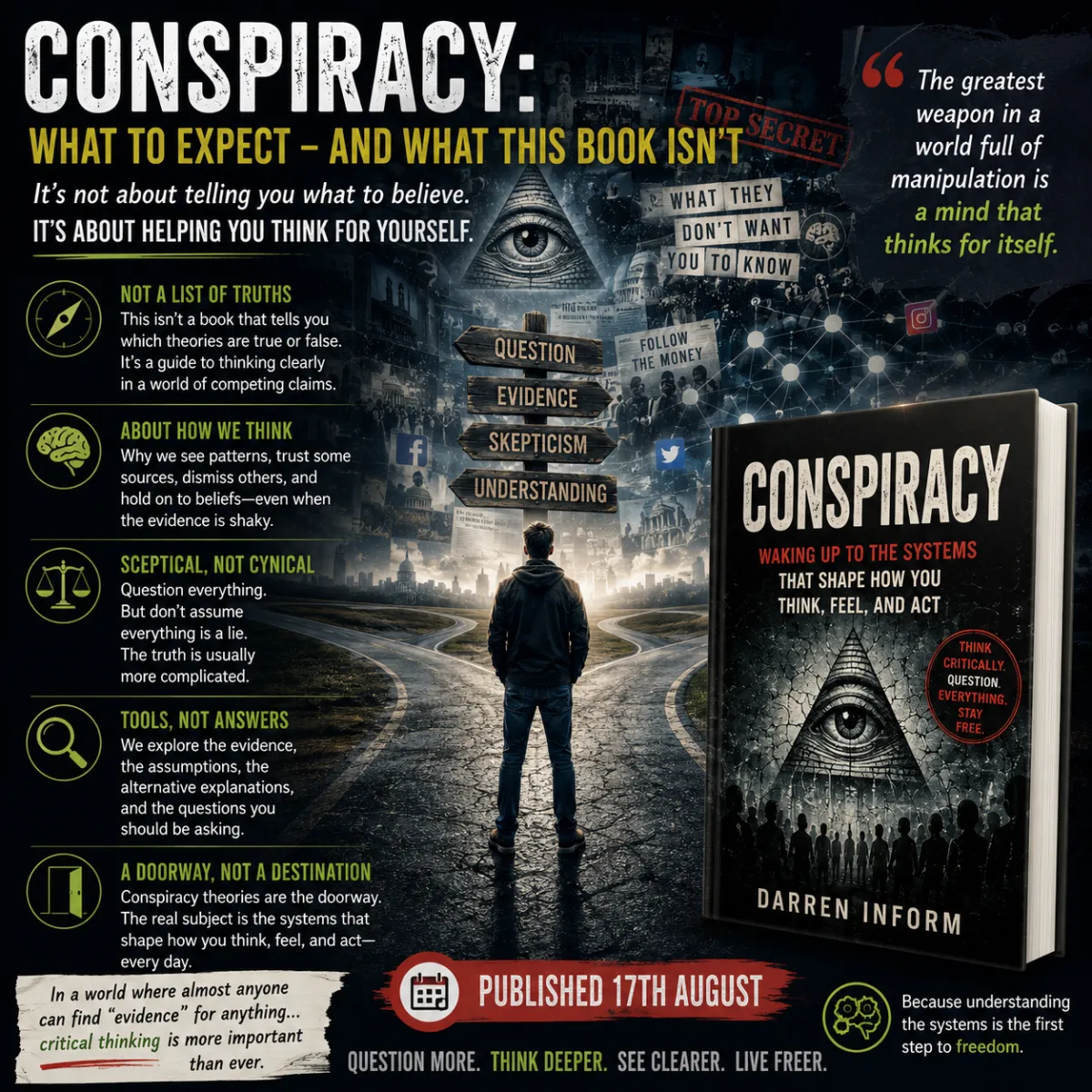
Conspiracy: What to Expect — and What This Book Isn't
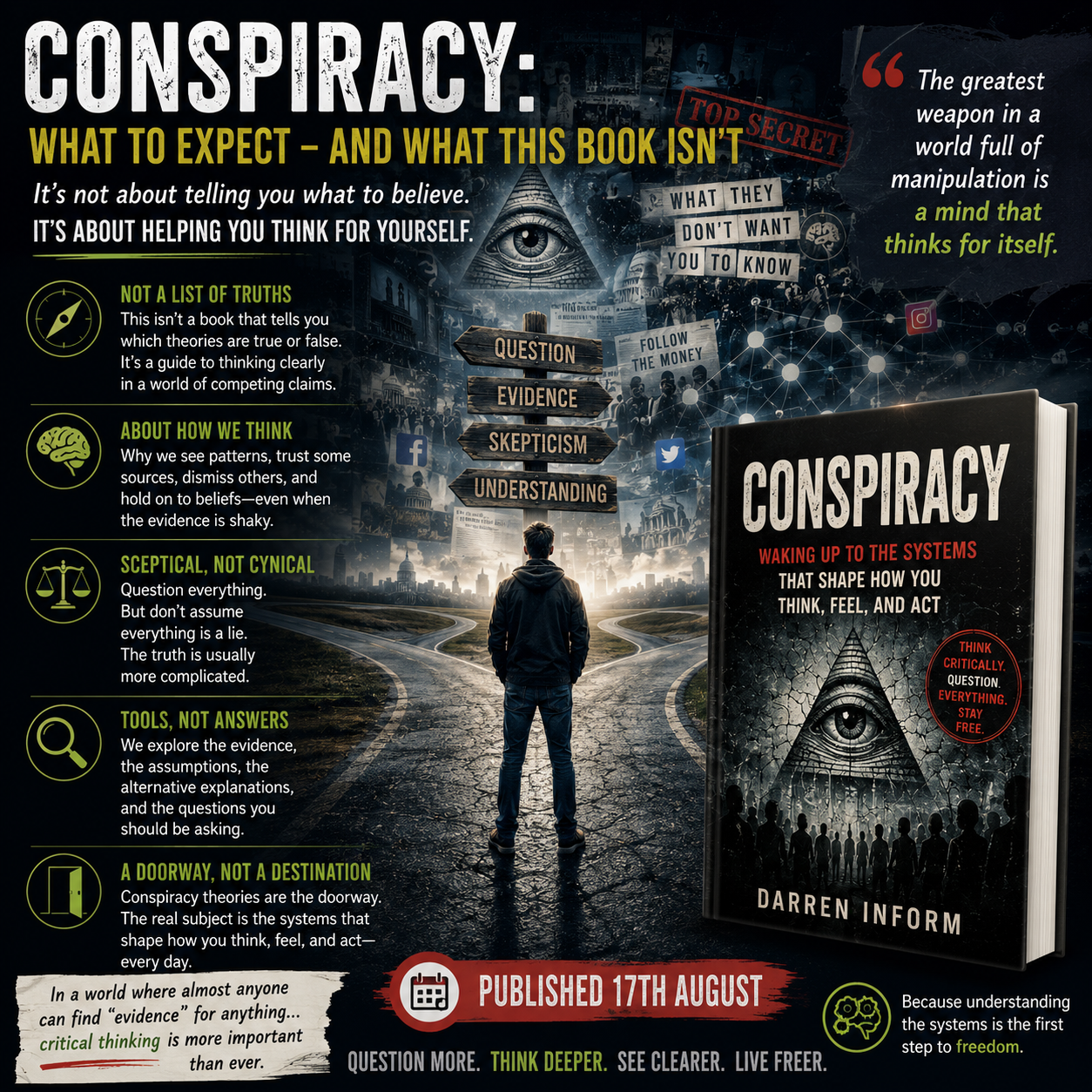
Conspiracy: What to Expect — and What This Book Isn't
There is a problem with writing a book called Conspiracy.
People think they already know what it's going to be about.
Aliens.
Secret societies.
Assassinations.
Government cover-ups.
Perhaps somebody wandering around Area 51 with a pair of binoculars.
And yes, some familiar conspiracy theories do appear in the book.
But here's the slightly awkward truth.
I didn't really write a book about conspiracy theories.
I wrote a book about how we think.
Conspiracy theories simply provide one of the most fascinating places from which to explore it.
Because once you start asking why people believe extraordinary things, you very quickly stumble into much bigger questions.
Why do we see patterns? Why do two intelligent people examine the same information and reach completely different conclusions? Why do we trust some sources but instinctively distrust others? Why are some beliefs remarkably resistant to contradictory evidence?
And perhaps most importantly...
How do any of us decide what is true?
This Isn't a Book About Stupid People
Let's get one thing out of the way immediately.
Believing something that turns out to be wrong does not make somebody stupid.
If it did, every one of us would qualify.
It's simply that human beings are extraordinarily good at finding patterns. It's one of the abilities that helped our ancestors survive.
The trouble is that we're sometimes so good at finding patterns that we discover them where none actually exist.
Then something else happens.
Once we've formed a belief, we become rather good at finding information that supports it. We notice some evidence. Dismiss other evidence. Remember certain examples. Forget inconvenient ones.
And increasingly, we inhabit information environments capable of feeding those existing beliefs back to us.
None of this requires stupidity.
It requires a human brain.
And you've got one too.
That's why Conspiracy isn't really about them.
It's about us.
I'm Not Going to Tell You What to Believe
This was important to me from the beginning.
I'm not interested in giving you a Darren-approved list of acceptable beliefs.
TRUE.
FALSE.
BELIEVE THIS.
DON'T BELIEVE THAT.
That would rather defeat the point.
Instead, I want us to examine the machinery underneath belief.
What evidence are we using? Where did it come from? What assumptions are we making? What alternative explanations exist? What would cause us to change our minds? And are we applying the same standards to evidence we agree with as we apply to evidence we dislike?
That last one can be uncomfortable.
But it's important.
Because critical thinking isn't something we should only apply to other people's beliefs.
The beliefs most deserving of examination are often our own.
Scepticism Isn't Cynicism
There's another distinction running throughout the book that I think matters enormously.
Being sceptical doesn't mean believing everyone is lying to you. Governments sometimes get things wrong. Corporations sometimes (and some would say too often) behave badly. Institutions sometimes protect themselves. Experts sometimes make mistakes.
History gives us plenty of examples.
So questioning authority can be perfectly rational.
But automatically assuming that every authority is lying isn't critical thinking either.
That's simply replacing one certainty with another.
Good scepticism asks:
What is the evidence?
How reliable is it?
What other explanations might fit?
What don't I know?
And perhaps the hardest question of all:
What evidence would persuade me that I'm wrong?
If the answer to that final question is nothing...
...then we're no longer investigating.
We're defending a belief.
Why Conspiracy Theories Matter
You might reasonably ask why we should bother studying conspiracy theories at all.
Because they're extraordinary windows into ordinary human behaviour.
They allow us to examine:
Pattern recognition.
Confirmation bias.
Identity.
Fear.
Belonging.
Distrust.
Social influence.
Propaganda.
Information systems.
The need for certainty.
And the stories human beings construct to make sense of complicated events.
But here's where things get particularly interesting. Those forces don't disappear when we stop talking about conspiracy theories.
They're present in:
Politics.
Business.
Advertising.
Social media.
News.
Relationships.
Workplaces.
Communities.
In fact, everywhere human beings exchange information and construct meaning.
Which is why the subtitle of the book matters so much:
Waking Up to the Systems That Shape How You Think, Feel, and Act.
The conspiracy theories are the doorway.
The real subject is everything on the other side.
The Information Paradox
We now have access to more information than almost any humans who have ever lived. And yet that hasn't necessarily made deciding what is true easier. Sometimes it has made it harder.
Search long enough online and you can probably find someone supporting almost any position imaginable. Algorithms can place information in front of us based partly on what has previously captured our attention. Communities form around shared interpretations of reality. Stories travel faster than corrections. Emotion can travel faster than evidence. And sheer repetition can make an idea begin to feel familiar.
This creates a strange paradox:
More information does not automatically produce more understanding.
Information requires interpretation. And interpretation requires thinking.
That's the territory Conspiracy explores.
What I Hope You Take From It
I don't expect everyone who reads Conspiracy to agree with me.
In fact, I'd be slightly worried if they did.
What I hope happens instead is that somewhere during the book you stop and think: Hang on. Why do I believe that?
Not necessarily because the belief is wrong.
Perhaps examining it will make you more confident that it's right.
But now you'll understand why.
If the book achieves anything, I hope it encourages a particular kind of curiosity.
Curiosity without gullibility.
Scepticism without cynicism.
Open-mindedness without abandoning standards of evidence.
And enough intellectual humility to occasionally utter three words that seem increasingly difficult in modern public debate:
I don't know.
Those aren't weak words.
Sometimes they're the beginning of genuine understanding.
One Final Thought
We're surrounded by people competing to tell us what to think.
Politicians.
Advertisers.
Influencers.
Campaigners.
Commentators.
Algorithms.
Friends.
Strangers.
And, yes, authors.
Including me.
You cannot remove all those influences.
But you can become more conscious of them.
You can examine the systems.
You can question the stories.
You can inspect your own assumptions.
And you can become better at deciding what deserves your belief.
That's what Conspiracy is really about.
Conspiracy: Waking Up to the Systems That Shape How You Think, Feel, and Act is published week commencing the 17th August.
But don't read it because you want me to tell you what to believe.
Read it because you're prepared to ask yourself something much more interesting:
Why do I believe what I believe?
Because Conspiracy doesn't ask you to believe me.
It asks you to become better at deciding what you believe — and why.
