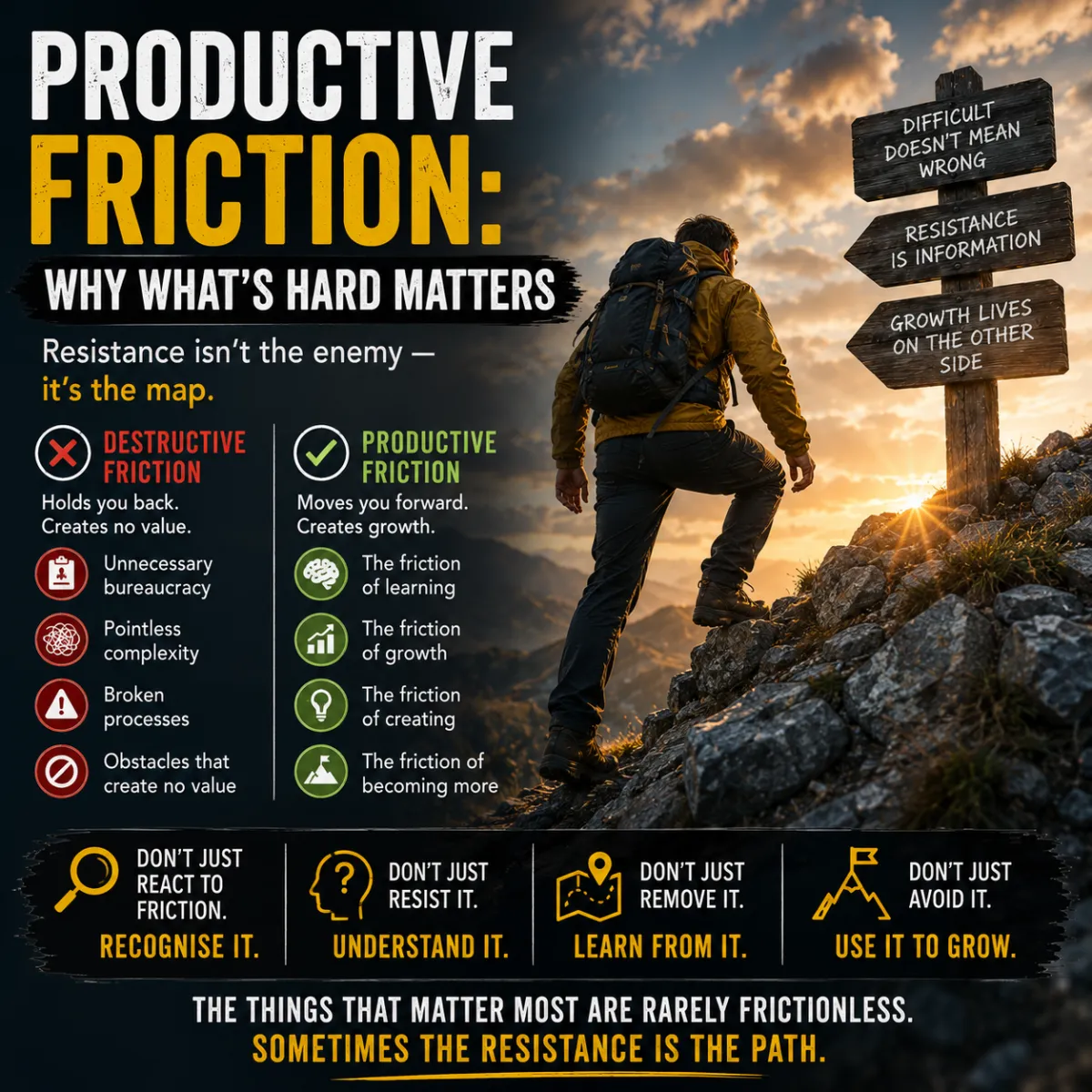
Productive Friction: Why What's Hard Matters
Productive Friction: Why What's Hard Matters
We live in a world that treats friction as a problem.
If something feels difficult, we assume we're doing it wrong. If progress slows down, we start looking for shortcuts. If resistance appears, we often take it as a sign that we should stop.
But what if friction isn't always the enemy?
What if some forms of resistance are actually showing us where growth lives?
Think about the things that matter most:
learning a new skill
writing a book
building a business
improving your health
changing long-held habits
None of these things are frictionless.
In fact, the difficulty is often part of the process.
The problem is that we've become conditioned to believe that progress should feel smooth. We expect confidence before action. Certainty before commitment. Mastery before practice.
Real life doesn't work that way.
Growth is often uncomfortable because you're moving beyond what is familiar. You're stretching existing capabilities. You're becoming somebody you haven't been before.
That's not failure.
That's adaptation.
Of course, not all friction is useful.
Some friction is simply bad design:
unnecessary bureaucracy
broken processes
pointless complexity
obstacles that create no value
Those things should be removed.
But productive friction is different.
Productive friction is the resistance that teaches you something.
It reveals gaps in your knowledge.
It exposes weak assumptions.
It highlights areas for improvement.
It forces you to think differently.
The next time you encounter resistance, don't immediately ask:
"How do I get rid of this?"
Ask:
"What is this trying to teach me?"
Because the things that matter most are rarely frictionless.
And sometimes the resistance isn't blocking the path.
Sometimes it is the path.
Reality Check
Not all friction is a sign to stop.
Sometimes it's a sign you're finally working on something important.
