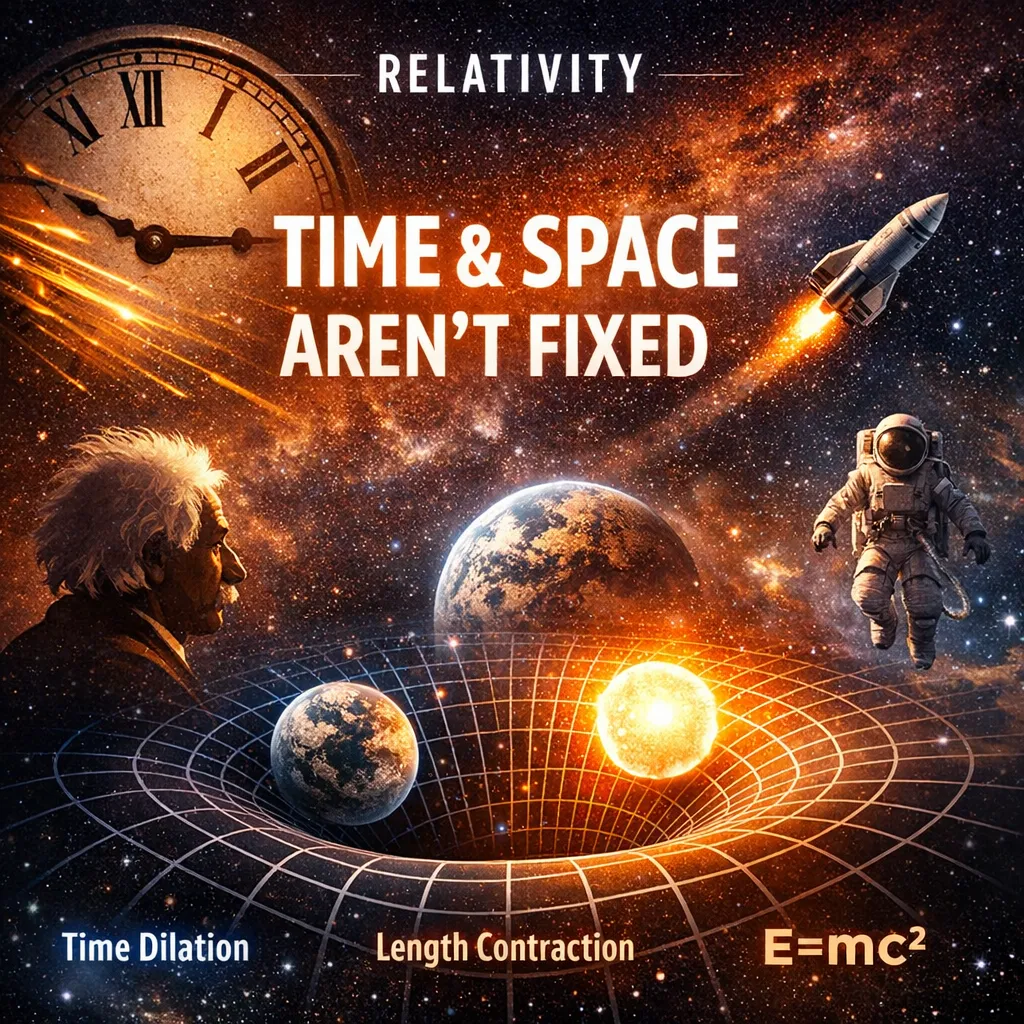
Relativity: The Game Changer of Modern Science (Part 1)
Relativity: The Game Changer of Modern Science (Part 1)
When time stopped being absolute
What if time isn’t what you think it is?
Take a moment.
Look at a clock.
You probably assume something simple:
Time is… time.
It moves forward.
At the same rate.
For everyone.
But what if that isn’t true?
What if time changes… depending on how fast you’re moving?
What if two people could experience time differently —
and both be right?
That’s the world Relativity introduced.
And once you see it…
you can’t unsee it.
The Moment Physics Broke
At the start of the 20th century, physics had a problem.
Two of its most successful theories didn’t agree:
Newton’s laws explained motion and gravity
Maxwell’s equations explained light and electromagnetism
Both worked incredibly well.
But together?
They didn’t quite fit.
Something deeper was missing.
And into that gap stepped a young patent clerk…
Albert Einstein.
The Radical Idea
In 1905, Einstein published a paper with a deceptively simple premise:
The laws of physics are the same for everyone…
and the speed of light never changes.
That second idea was the shock.
Because it meant this:
No matter how fast you’re moving…
no matter where you’re observing from…
👉 the speed of light is always the same.
Think about that for a second.
If you’re standing still — you measure it the same.
If you’re moving at incredible speed — you still measure it the same.
So something else has to give.
And what gives…
is our understanding of space and time.
Special Relativity — The First Breakthrough
Einstein’s first theory — Special Relativity — changed everything.
It told us that space and time are not fixed.
They are flexible.
Dependent on motion.
Three ideas that rewrote reality:
1. Time Dilation
Time doesn’t move at the same rate for everyone.
If you’re moving faster…
time slows down — relative to someone who isn’t.
In extreme cases?
Someone travelling close to the speed of light could age more slowly than someone on Earth.
2. Length Contraction
Objects don’t just move differently.
They measure differently.
At high speeds, objects actually contract in the direction they’re travelling.
3. Simultaneity Breaks
Two events that look simultaneous to one observer…
might not be simultaneous to another.
So even the idea of “now”…
is no longer universal.
The Equation That Changed Everything
From this came one of the most famous equations in history:
E = mc²
It tells us something profound:
Mass and energy are not separate.
They are interchangeable.
A small amount of mass…
can become a vast amount of energy.
This idea sits behind:
nuclear energy
the power of stars
and much of modern physics
The Thought That Started It All
There’s a story about Einstein.
Sitting at work.
Looking at a clock.
And asking a simple question:
“How do I know what time it is?”
That question leads somewhere unexpected.
Because to know the time…
you rely on light reaching your eyes.
So what happens if:
you move toward the light?
you move away from it?
you travel alongside it?
Follow that line of thinking far enough…
and you end up here:
The speed of light is the limit of the universe.
Nothing with mass can reach it.
Nothing can exceed it.
And if that’s true…
then time and space must adjust around it.
Why This Changed Everything
Before Relativity, the universe was simple:
Time was absolute
Space was fixed
Gravity was a force
After Relativity?
Everything became connected.
Space and time merged into spacetime.
Motion changed how reality was measured.
And the universe became… relative.
Newton wasn’t wrong.
But his laws were incomplete.
They worked at everyday speeds…
But not at the extremes.
Relativity filled that gap.
And in doing so…
it reshaped science forever.
The Bigger Shift (ThinkWORKS Lens)
This isn’t just a physics story.
It’s a thinking story.
Because what Einstein really did…
was question something everyone else assumed was fixed.
Time.
And in doing that…
he revealed something deeper:
What we think is “absolute”… often isn’t.
Where We Go Next
So far, we’ve looked at how motion changes time and space.
But there’s a bigger question:
👉 What about gravity?
In Part 2, we’ll explore:
How Einstein redefined gravity itself
Why massive objects bend reality
And how this led to black holes, gravitational waves…
and the structure of the universe
Because if Special Relativity bent time…
General Relativity reshaped the cosmos.
🔗 ThinkWORKS Reflection
What assumptions are you treating as fixed…
that might actually be relative?
