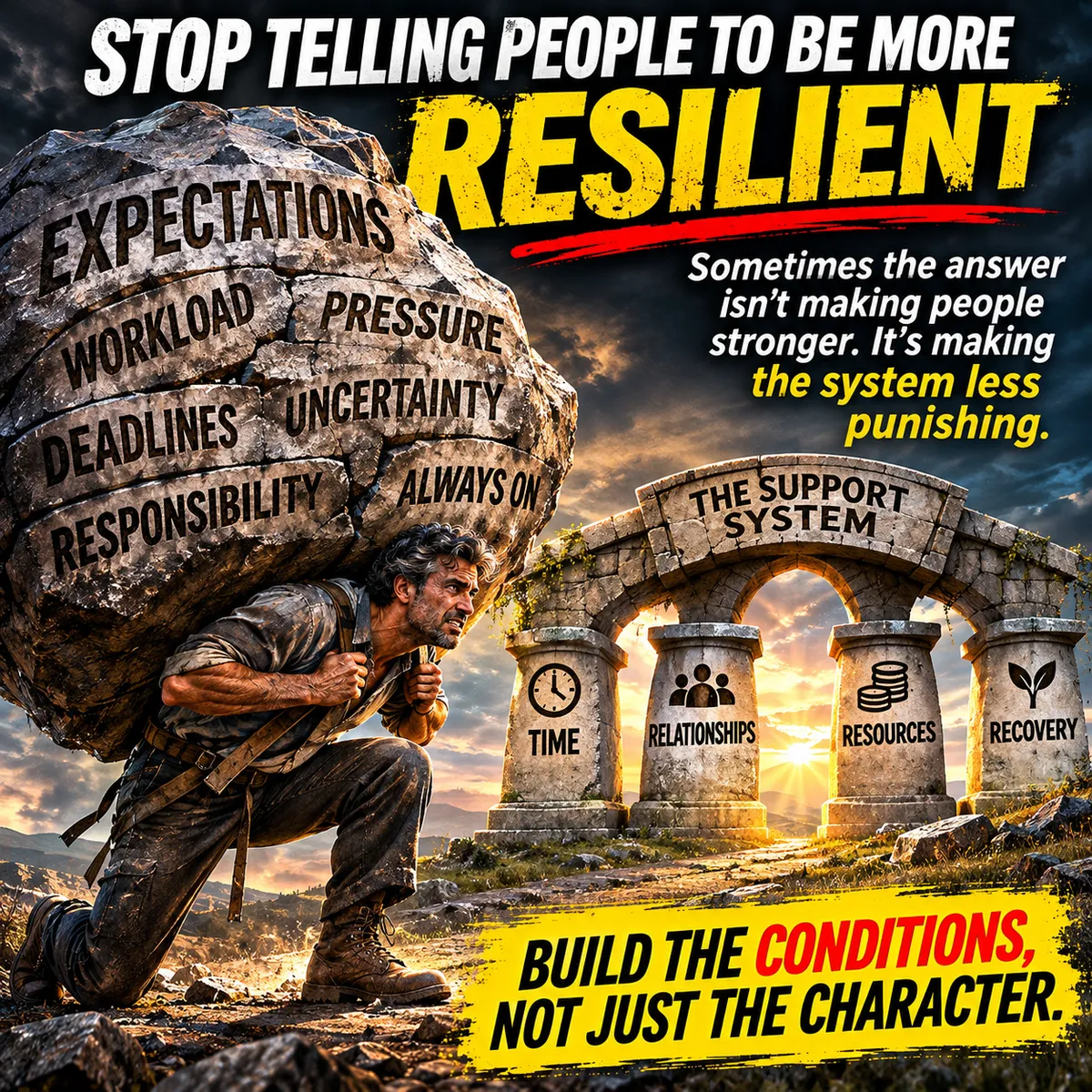
Stop Telling People to Be More Resilient
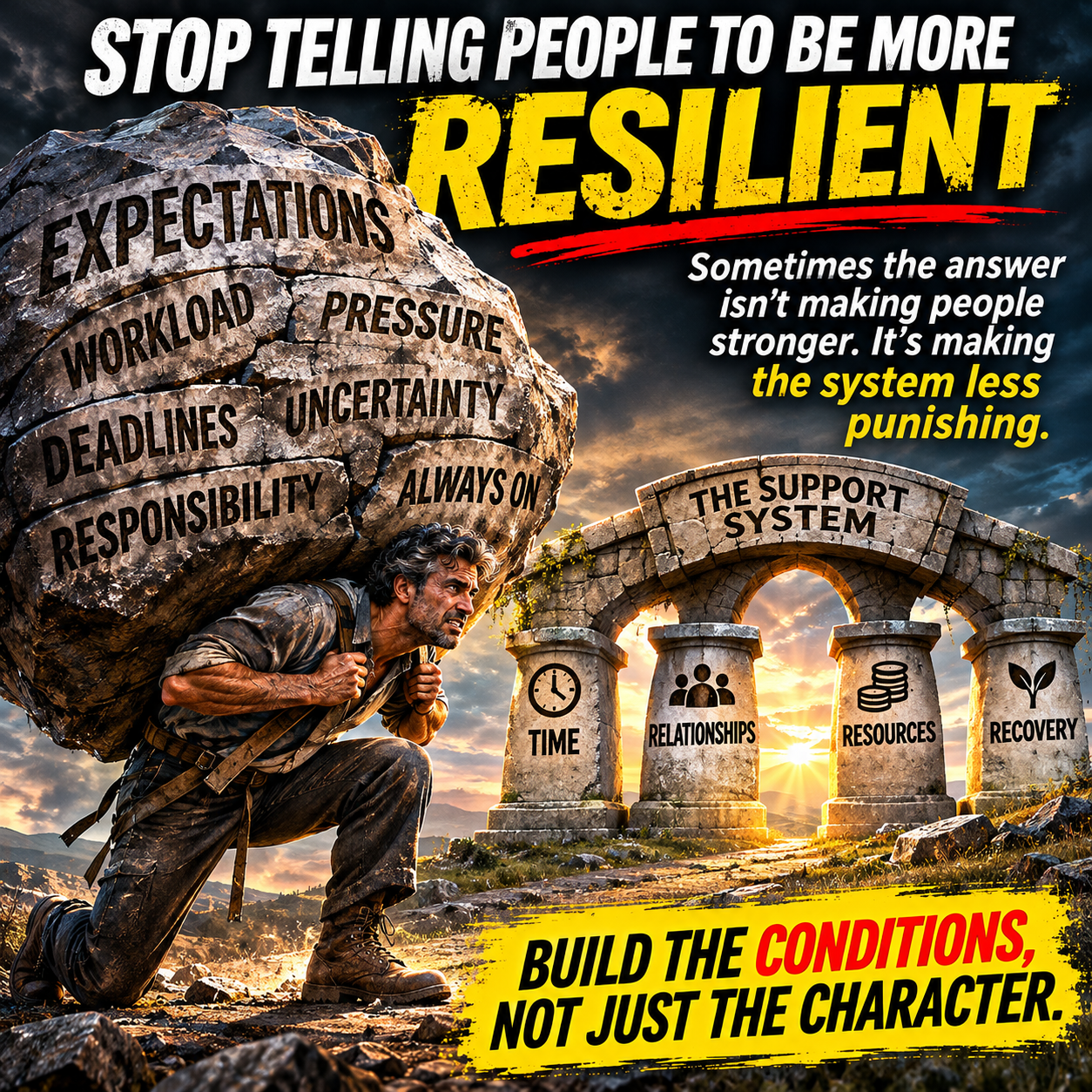
Stop Telling People to Be More Resilient
Why Coping Better Isn't Just About Becoming Tougher
There's a phrase we've become remarkably fond of in recent years.
You need to be more resilient.
We hear it everywhere.
In workplaces.
In schools.
In discussions about mental health.
In personal development.
In conversations about leadership, productivity and dealing with change.
Something difficult happens?
Be resilient.
Feeling overwhelmed?
Build resilience.
Struggling to cope?
Develop a more resilient mindset.
And there's nothing inherently wrong with the idea.
Being able to adapt, recover and keep going through difficult circumstances is enormously valuable.
But I've been wondering whether we're sometimes asking the wrong question.
Because when somebody is struggling, perhaps the most useful response isn't always:
“How can we make this person tougher?”
Perhaps we should also be asking:
“What is making their circumstances so difficult to cope with in the first place?”
And some interesting new research suggests that's a question worth taking seriously.
Resilience Is More Complicated Than We Think
A study published in Nature Mental Health in October 2026 examined psychological resilience using data from a longitudinal population cohort in Hong Kong.
The research involved 26,210 people.
Rather than concentrating on a single personality trait or psychological technique, the researchers examined a wide range of possible influences on resilience.
They identified and validated 35 predictors across seven domains.
These included factors connected with health, relationships, meaning, financial stability and behaviour.
Now, there's an important distinction here.
The study identified associations that could predict later resilience. It doesn't prove that changing any particular factor will automatically make somebody more resilient.
But the broader picture is fascinating.
Resilience wasn't associated with just one aspect of a person's life.
It was connected with multiple aspects of the environment in which that person lives.
And that raises an important possibility.
Perhaps resilience isn't simply something we possess. Perhaps it's also something our circumstances make easier or harder to sustain.
The Problem With the Toughness Narrative
Imagine two people facing the same difficult situation.
Both experience a sudden financial setback.
Both have an unexpected expense.
Both need to find a way through it.
The first person has some savings.
A supportive family.
A relatively secure job.
A manageable workload.
And people they can turn to for help.
The second person has no savings.
Uncertain employment.
Caring responsibilities.
Existing debts.
And very little practical support.
Now imagine telling both of them:
You just need to be more resilient.
Does that sound like equally useful advice?
Of course not.
The first person has resources and relationships that may help them absorb the shock.
The second person may be forced to deal with the same problem while simultaneously managing several others.
Their ability to recover isn't determined solely by their attitude.
It's also affected by the options available to them.
The resources they can draw upon.
The pressures they're already experiencing.
And the systems surrounding them.
That doesn't mean individual resilience is irrelevant.
It means individual resilience doesn't operate in a vacuum.
You cannot properly understand how somebody copes without understanding what they're coping with.
When Resilience Becomes an Excuse
Now let's take this into the workplace.
An organisation has a problem.
Employees are exhausted.
Workloads are increasing.
Staff turnover is rising.
People are struggling to maintain concentration and motivation.
What does the organisation do?
Perhaps it introduces a resilience workshop.
A wellbeing programme.
A mindfulness app.
A presentation about managing stress.
And some of those things may genuinely help.
I'm not dismissing them.
But suppose the underlying problems remain unchanged.
The excessive workload.
The confusing processes.
The unrealistic deadlines.
The lack of control.
The constant interruptions.
The expectation that everybody should somehow achieve more with fewer resources.
What have we actually accomplished?
We've offered people tools to cope with a system that continues to create the problem.
And then, if they still struggle, we risk treating their difficulty as evidence that they haven't developed sufficient resilience.
That's a dangerous reversal of responsibility.
Because teaching people to cope with a bad system is not the same as improving the system.
And sometimes we need to do both.
The Difference Between Coping and Recovering
There's another distinction worth exploring.
Coping and recovering aren't necessarily the same thing.
You can cope with an unreasonable workload for a while.
You can work longer hours.
Sacrifice leisure time.
Cancel plans.
Ignore tiredness.
Push through.
And from the outside, you might appear remarkably resilient.
You're still turning up.
Still delivering.
Still meeting expectations.
But what happens when the immediate pressure ends?
Are you able to recover?
Or have you simply accumulated exhaustion?
This matters because resilience shouldn't mean an unlimited ability to tolerate difficult circumstances.
It should include the capacity to regain stability after disruption.
And recovery often requires things that aren't simply matters of willpower.
Time.
Rest.
Support.
Security.
Opportunity.
A manageable environment.
A sense of purpose.
And enough flexibility to adjust when circumstances change.
In other words, the conditions surrounding us matter.
Surviving pressure isn't necessarily the same as recovering from it.
The Quiet Systems That Help Us Cope
This connects with an idea I've been developing in ThinkWORKS.
I call them Quiet Systems.
These are the often-unremarkable structures, routines, relationships and arrangements that make life work better without demanding constant attention.
A reliable routine.
A supportive colleague.
A manageable household budget.
A clear process.
A realistic schedule.
Somebody who can help when things go wrong.
None of these sounds particularly dramatic.
They don't make for especially exciting motivational speeches.
But they can make an enormous difference to how manageable everyday life becomes.
Think about a bridge.
We don't make a bridge stronger simply by telling it to withstand more weight.
We examine its structure.
Its materials.
Its supports.
Its maintenance.
The loads placed upon it.
And the conditions in which it operates.
Why, then, do we so often approach human resilience as though it were purely a question of personal toughness?
People aren't bridges, of course.
But the systems principle is useful.
Strength depends partly on the support structure.
And perhaps one of the most effective ways to help people become more resilient is to improve the conditions that make recovery possible.
Resilience and the Myth of the Self-Sufficient Individual
There's a particular cultural story that I think deserves challenging.
The idea that strong people manage everything themselves.
They don't need help.
They don't complain.
They don't rely on others.
They simply get on with it.
It's an appealing image.
The independent individual.
The person who overcomes every obstacle through determination alone.
And determination certainly matters.
But independence doesn't mean existing without support.
Even the most capable people depend upon systems and relationships.
We depend on infrastructure.
Healthcare.
Education.
Transport.
Communication.
Employment.
Families.
Friends.
Communities.
And countless other arrangements that make everyday life possible.
The fact that these supports are often invisible doesn't make them unimportant.
Indeed, we frequently notice their importance only when they stop working.
A cancelled train.
A broken computer.
A lost income.
An unavailable carer.
A disrupted routine.
Suddenly, something that seemed effortless becomes extraordinarily difficult.
Not necessarily because we've become less capable.
But because a supporting system has disappeared.
And that's worth remembering when judging somebody else's ability to cope.
What Leaders Should Be Asking
For managers and organisational leaders, this creates a useful challenge.
Instead of asking only:
“How do we make our people more resilient?”
Try asking:
“What are we doing that makes resilience harder than it needs to be?”
Are workloads realistic?
Do employees have sufficient control over how they work?
Are processes unnecessarily complicated?
Can people ask for help without being judged?
Are mistakes treated as opportunities to learn or reasons to blame?
Do people have time to recover after periods of intense demand?
And are we measuring the right things?
Because an organisation can appear highly productive while quietly exhausting the people responsible for that productivity.
It can hit every target.
Meet every deadline.
Improve every performance indicator.
And still be making itself less capable of coping with the next disruption.
That's not organisational resilience.
It's the gradual consumption of organisational capacity.
A resilient organisation isn't simply one that keeps demanding more from its people. It's one that preserves their ability to respond when more is genuinely needed.
What About Personal Responsibility?
Now, I can already hear an objection.
Surely people still need to take responsibility for their own resilience?
Absolutely.
Personal agency matters.
We can develop healthier habits.
Strengthen relationships.
Improve how we manage our time.
Learn new skills.
Ask for help.
Examine our assumptions.
And make better decisions about the things within our control.
Those are important parts of personal development.
But here's the distinction.
Personal responsibility doesn't mean pretending that every problem has a personal solution.
Sometimes the right response is to change our behaviour.
Sometimes it's to change our environment.
And sometimes it's to recognise that a problem cannot reasonably be solved by one person acting alone.
This is where systems thinking and practical psychology complement each other.
Psychology helps us understand how people respond.
Systems thinking helps us understand the conditions shaping those responses.
And agency helps us identify what we can realistically do next.
We need all three.
A Different Kind of Resilience Audit
So here's a practical exercise.
Think about an area of your life where you're currently under pressure.
It might be work.
Family responsibilities.
Finances.
A personal project.
Or simply the accumulation of everyday demands.
Now, instead of asking how you can become tougher, ask yourself four questions.
1. What is placing the greatest demand on me?
Be specific.
Not simply life is stressful, but what is actually creating the pressure?
2. What currently helps me cope?
Think about routines, people, resources, knowledge and arrangements that make the situation more manageable.
3. What is making recovery more difficult?
Are there unnecessary obstacles?
Unrealistic expectations?
Missing support?
Too little time?
Problems that keep recurring because nothing changes?
4. What is one small thing I could strengthen, simplify or change?
Perhaps it's a conversation.
A boundary.
A better routine.
A request for assistance.
A process that needs simplifying.
Or an expectation that needs reconsidering.
The objective isn't to redesign your entire life in one afternoon.
It's to recognise that resilience may improve when we strengthen the systems supporting us.
And that's often a much more practical starting point than simply demanding greater determination.
Stop Asking People to Carry Everything
I think there's something rather important hidden inside this discussion.
We admire people who keep going through difficult circumstances.
And rightly so.
But admiration can become a problem if it prevents us from questioning why those circumstances are so difficult in the first place.
We celebrate the employee who works through exhaustion.
The parent who somehow manages everything.
The individual who overcomes extraordinary obstacles.
The organisation that survives repeated crises.
But sometimes, instead of simply applauding the struggle, we ought to ask whether some of that struggle was avoidable.
Because making life unnecessarily difficult isn't a prerequisite for developing strength.
And constantly testing people's ability to cope isn't necessarily evidence of good leadership.
Perhaps real progress means creating conditions in which people don't have to spend so much of their energy simply staying afloat.
That doesn't remove every challenge.
It doesn't guarantee an easy life.
And it certainly doesn't eliminate the need for determination.
But it changes where we look for solutions.
Build the Conditions, Not Just the Character
So the next time somebody tells you that people need to become more resilient, consider asking a different question.
What would make resilience easier?
What support is missing?
What pressure could be reduced?
What process could be improved?
What relationship could be strengthened?
What would give people more room to recover?
Because the October research reminds us that resilience is associated with multiple aspects of people's lives, not simply one psychological characteristic.
And that gives us a more complete way to think about the problem.
Yes, help people develop the skills to cope.
Yes, encourage agency, learning and adaptability.
But don't stop there.
Examine the systems around them.
Strengthen the supports.
Remove unnecessary obstacles.
And create environments in which people have a realistic opportunity to recover when things go wrong.
Because perhaps the question isn't simply whether somebody is strong enough to carry the weight.
Perhaps we should also ask why they're being expected to carry so much of it alone.
And that's something worth thinking about.
Think better. Work better. Build better.
Inspired by “Understanding psychological resilience: a longitudinal environment-wide study”, published in Nature Mental Health, 20 October 2026. The study identified prospective associations across multiple domains; the organisational and practical recommendations in this article are wider systems-thinking interpretations, not interventions proven by the study.
From ThinkWORKS and DarrenInform — helping people think more clearly so they can build better lives, businesses and communities.
