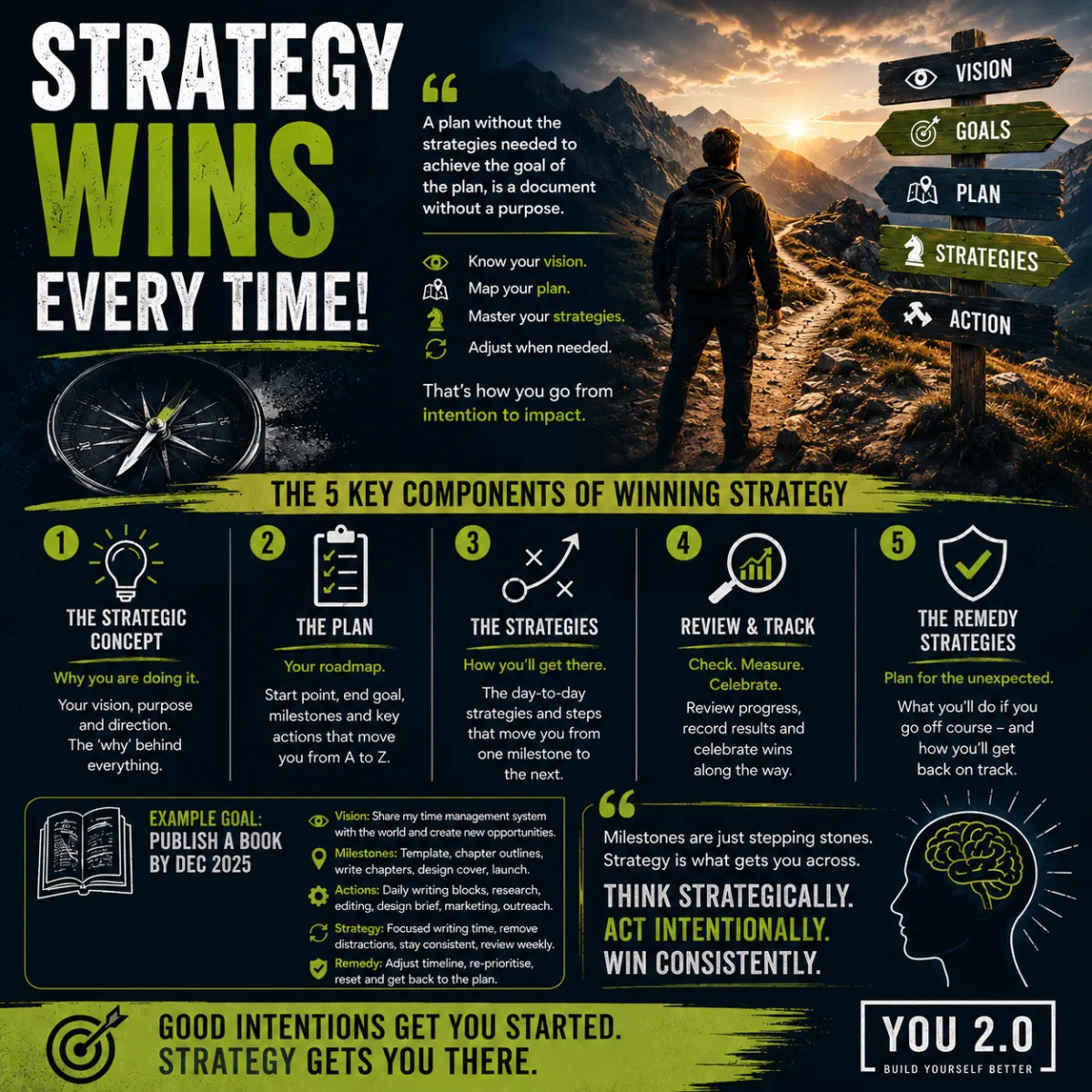
Strategy Wins Every Time
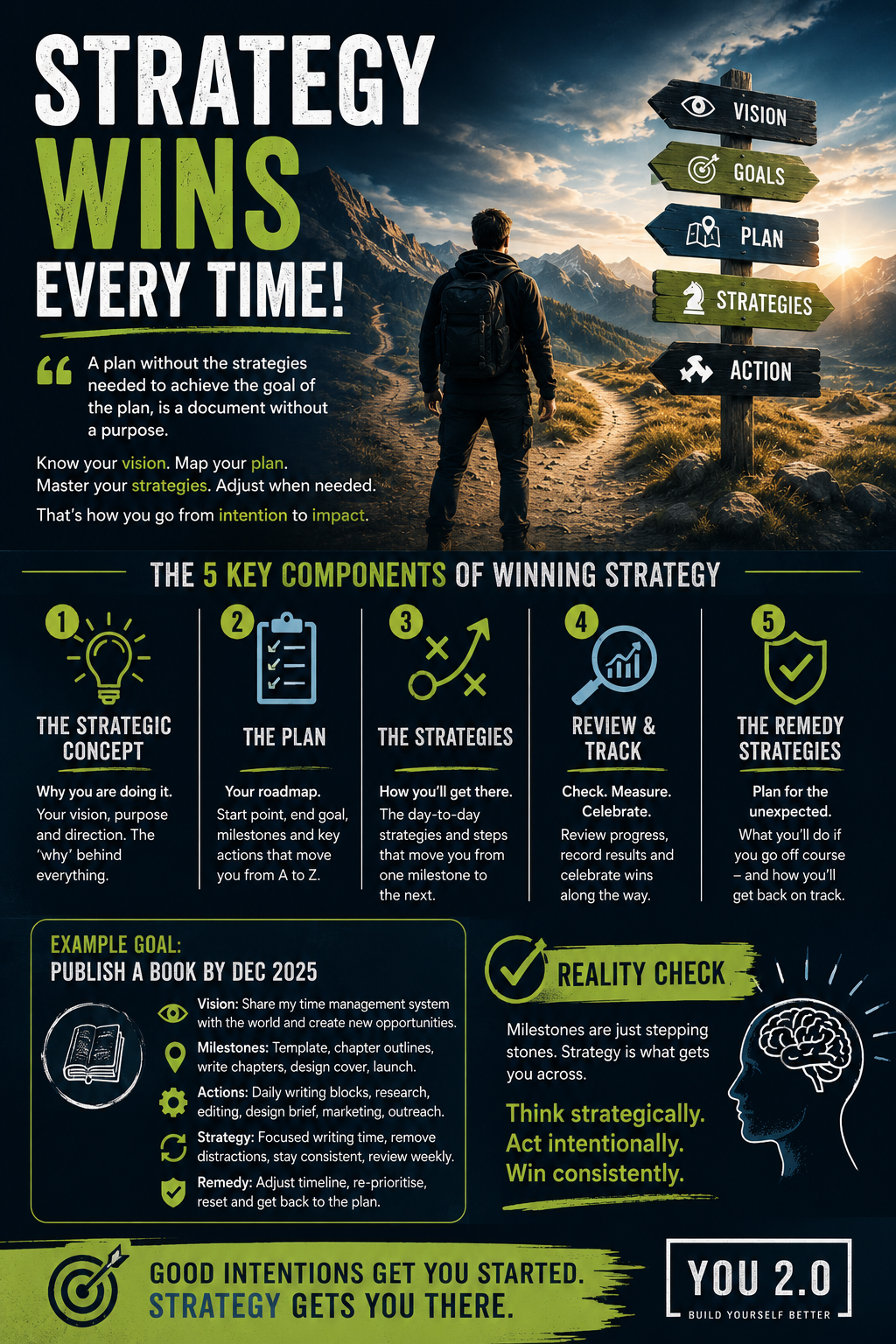
Strategy Wins Every Time
Why Good Intentions Mean Nothing Without the Right Strategy
Most people think having a goal is enough.
It isn’t.
A goal without the right strategy behind it is just wishful thinking with better formatting.
That might sound harsh, but it explains why so many people set goals they never reach. They create plans, milestones, and deadlines, but never properly think about the how. They know where they want to go, but not the practical systems and behaviours required to actually move them there.
And that’s where things usually start to fall apart.
The Mistake Most People Make
A lot of people confuse:
goals
plans
and strategies
…as if they are all the same thing.
They’re not.
A vision tells you why you want something.
A plan tells you what needs to happen.
A strategy tells you how you’re actually going to make it work consistently in the real world.
That distinction matters enormously because a plan on its own doesn’t magically create progress. You can fill a notebook with milestones and still never move forward if the day-to-day strategy underneath those milestones is weak.
In other words:
milestones are not strategies.
They are stepping stones.
The strategy is what gets you to the next stone without falling in the water.
Why Strategy Matters More Than Motivation
Motivation is unreliable.
Some days you feel unstoppable.
Other days you can barely focus long enough to answer an email.
That’s normal.
Which is exactly why strategy matters.
Good strategy reduces reliance on mood. It creates conditions that make action easier even when energy, focus, or confidence are low.
Let’s say your goal is to write a book.
You can absolutely put:
“Write Chapter One”
…into your plan.
But that alone means very little.
The real question is:
How are you going to make that happen consistently?
If your “strategy” is:
“I’ll just write when I feel inspired”
…then good luck.
But if your strategy becomes:
clear two hours every evening
remove distractions
put the phone away
create a focused environment
repeat consistently
…you suddenly move from vague ambition into practical execution.
That’s the difference between hoping and building.
Systems Beat Intention
This is one of the biggest lessons I’ve learned over the years:
Good intentions are fragile.
Good systems are resilient.
Most people already know what they should be doing:
exercising
planning properly
writing consistently
having difficult conversations
improving their finances
building healthier routines
Knowledge usually isn’t the problem.
Structure is.
The people who make progress long-term are rarely the ones with the most motivation. They are usually the ones with the clearest systems and the most repeatable strategies.
Because strategy creates momentum.
And momentum changes everything.
Strategy Also Means Preparing for Failure
This is the part many people ignore completely.
Real strategy includes contingency.
What happens when:
life gets chaotic?
motivation drops?
you miss a milestone?
unexpected problems appear?
your original timeline falls apart?
Most plans fail not because the goal was impossible, but because people assumed nothing would interrupt the process.
Something always interrupts the process.
That’s why remedy strategies matter.
If you miss a week, what happens next?
Do you quit?
Or do you already have a built-in recovery system ready to go?
The people who succeed are not usually the people who never go off track.
They are the people who know how to get back on track quickly.
The Bigger Truth
Ultimately, strategy is about alignment.
Making sure:
your environment
your habits
your routines
your behaviours
your time
and your systems
…all support the direction you claim you want to go in.
Because saying:
“I want to change my life”
means very little if your daily systems still support the old version of you.
That’s the hard truth.
But it’s also the hopeful one.
Because systems can be redesigned.
Strategies can be improved.
And once you start thinking strategically rather than emotionally, progress stops feeling random.
It becomes repeatable.
Reality Check
A vision without a plan is fantasy.
A plan without a strategy is frustration.
But a clear strategy, repeated consistently over time?
That’s where real change starts.
