The Knowledge Trap: Why Knowing More Doesn't Mean Moving Forward
The Knowledge Trap: Why Knowing More Doesn't Mean Moving Forward
We have more information, advice and expertise available than ever before. So why do individuals, businesses and entire organisations still struggle to turn what they know into meaningful change?
By Darren Smithson | ThinkWORKS
We live in the age of information.
If you want to learn how to run a business, improve your productivity, manage your finances, develop better habits or become a more effective leader, there's no shortage of advice.
There are books, podcasts, webinars, training courses, online communities and countless experts offering their insights.
And now, of course, there's artificial intelligence.
We can ask a question and receive a detailed response in seconds. We can generate business plans, identify potential problems, analyse processes and produce recommendations faster than ever before.
In many respects, we've never had it so good.
But here's something that's been bothering me.
If access to knowledge is the key to progress, why are so many people and organisations still struggling to move forward?
Why do businesses commission expensive reports only to carry on doing much the same things?
Why do people attend training courses, feel wonderfully motivated for a few days, and then gradually return to their old habits?
Why do we repeatedly identify problems, agree that something must change, and then spend months — sometimes years — discussing what we've already established?
Perhaps the answer is that we've been confusing knowledge with progress.
And recent research offers an interesting way of understanding why.
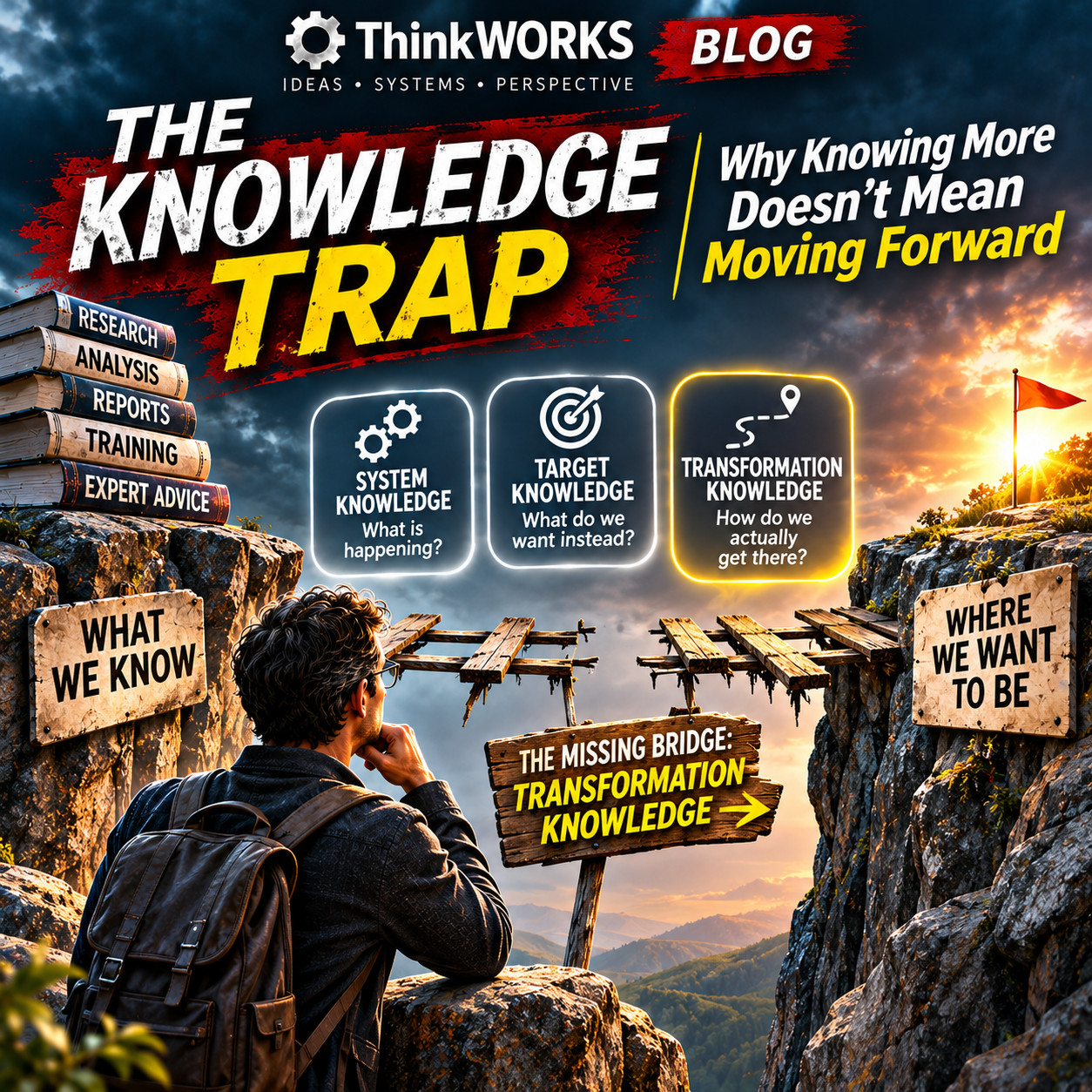
Three Kinds of Knowledge
A study published in npj Climate Action in November 2026 examined a project involving twelve German municipalities.
The researchers were interested in how people and institutions could work together to develop practical responses to complex challenges.
One of the particularly useful ideas emerging from this work concerns three different kinds of knowledge.
The first is system knowledge.
This is our understanding of how things currently work.
What is happening? What causes the problems we're experiencing? Which factors influence the outcomes?
The second is target knowledge.
This concerns the future we're trying to create.
What should a better situation look like? What are we trying to achieve? What would success mean?
And the third is transformation knowledge.
This is the crucial one.
How do we actually move from the system we've got to the outcome we want?
What needs to change? Who needs to act? Which obstacles must be overcome? What interventions might work in these particular circumstances?
The distinction might sound obvious.
But I suspect it explains an enormous amount of the frustration we encounter in everyday life.
Because we can become very good at understanding a problem.
We can become equally good at describing the solution we'd like.
And still have absolutely no workable plan for getting from one to the other.
That's the knowledge trap.
Knowing the Problem Isn't Solving the Problem
Let's imagine a business experiencing declining productivity.
Management commissions a review.
The consultants investigate.
Employees complete surveys.
Performance data is collected and analysed.
Eventually, a report arrives.
It identifies poor communication, inefficient processes, outdated technology and unclear responsibilities.
Excellent.
We now understand the problem.
The report then recommends better communication, improved processes, modern technology and clearer responsibilities.
Wonderful.
We now know what a better organisation might look like.
But here's the question.
What happens on Monday morning?
Who is going to change the processes?
Who has the authority to challenge established working practices?
Where will the resources come from?
What happens when two departments disagree about the proposed changes?
How will employees find the time to implement improvements while continuing to deliver their existing workloads?
And what happens when the changes produce unexpected consequences?
These aren't minor administrative details.
They're the difference between a report that describes improvement and a process that actually delivers it.
Yet organisations can spend extraordinary amounts of money acquiring knowledge without investing sufficiently in the mechanisms required to turn that knowledge into action.
The result?
Another report.
Another initiative.
Another presentation.
And eventually, another review explaining why the previous recommendations weren't implemented.
Sometimes we don't have a knowledge problem at all.
We have a transformation problem disguised as a knowledge problem.
Why Change Doesn't Follow a Straight Line
A second study published in November 2026 reinforces this point.
Researchers examined fifteen years of digital transformation within a Swedish municipality.
What they found challenges the familiar idea that organisational change is a straightforward journey from an outdated system to a modern one.
Instead, change unfolded through repeated tensions between technology, established professional values, organisational authority and everyday working practices.
Progress involved ongoing processes of negotiation, control and consolidation.
In other words, implementing new technology wasn't simply a matter of explaining its benefits and telling everyone to get on with it.
Different groups had different priorities.
Existing practices served purposes that weren't always obvious to outsiders.
And changes that appeared beneficial from one perspective could create genuine difficulties from another.
This matters because organisations often interpret resistance as evidence that people don't understand the change.
So what do they do?
They provide more information.
More presentations.
More training.
More communication.
But what if the people resisting understand the proposal perfectly well?
What if their concerns arise from competing responsibilities, professional judgement, practical constraints or a legitimate disagreement about the proposed solution?
In those circumstances, more information may achieve very little.
The problem isn't necessarily a lack of understanding.
It's that the organisation hasn't resolved the competing demands that make implementation difficult.
And that's an important distinction.
Because you cannot solve every disagreement by explaining your preferred answer more loudly.
Sometimes you have to change the conditions under which people are being asked to act.
The Personal Development Version of the Knowledge Trap
Now, let's bring this a little closer to home.
Because this isn't simply an organisational problem.
I think the knowledge trap is particularly relevant to personal development.
And I say that as someone who has spent a considerable amount of time writing about how people can improve their lives.
In You 2.0: Build Yourself Better, I explore the importance of understanding ourselves, examining our assumptions and developing more effective habits.
Knowledge matters.
Of course it does.
But knowledge alone doesn't change behaviour.
Consider someone who wants to become healthier.
They understand the benefits of exercise.
They know that regular physical activity can improve wellbeing.
They've read the articles, watched the videos and perhaps even bought a book on the subject.
They know what they want.
They know why it matters.
But nothing changes.
Why?
Perhaps their working hours are unpredictable.
Perhaps they're exhausted by the time they get home.
Perhaps they don't have an enjoyable or practical way of exercising.
Or perhaps they've developed routines that make doing something different surprisingly difficult.
Another article explaining the benefits of exercise probably isn't going to solve those problems.
They already know.
What they need is a workable route from their present circumstances to a different pattern of behaviour.
And the same applies to financial planning, time management, relationships, career development and countless other areas of life.
We can become remarkably knowledgeable about the things we ought to be doing.
Without becoming particularly effective at doing them.
When Learning Becomes a Substitute for Action
There's another uncomfortable possibility.
Sometimes acquiring more knowledge can become a way of avoiding the uncertainty involved in making a change.
Think about somebody who wants to start a business.
They read books about entrepreneurship.
They follow successful business owners.
They attend webinars, research markets and develop increasingly detailed plans.
All worthwhile activities.
But eventually, they need to test an idea with real customers.
And that involves risk.
The idea might fail.
Someone might criticise it.
The assumptions might prove wrong.
So instead, they do a little more research.
And then a little more.
Because researching feels productive.
Planning feels responsible.
Learning feels like progress.
And sometimes it is.
But there comes a point where acquiring additional information produces diminishing returns.
The next useful piece of knowledge may not be found in another book.
It may come from trying something, observing what happens and learning from the result.
This is where transformation knowledge becomes practical.
It isn't necessarily about having a perfect plan.
It's about understanding enough to take a sensible next step, test an assumption and adapt.
Sometimes we don't need to know more before we act.
We need to act in order to discover what we need to know next.
Artificial Intelligence and the Illusion of Progress
And this brings us back to AI.
Because artificial intelligence has the potential to make the knowledge trap considerably more interesting.
We can now generate reports, strategies, analyses and recommendations at extraordinary speed.
A business can produce a detailed improvement plan in minutes.
An individual can ask an AI assistant to design a new routine, identify career opportunities or develop a learning programme.
That's genuinely useful.
But there's a danger in confusing the production of an answer with the achievement of an outcome.
An AI-generated business plan isn't a functioning business.
A productivity strategy isn't improved productivity.
A list of recommended habits isn't a changed life.
And a beautifully formatted transformation roadmap isn't evidence that an organisation has transformed.
AI can help us understand problems and explore possible solutions.
It may even help us identify useful interventions.
But implementation still involves real people, real constraints, competing priorities, established behaviours and consequences that cannot always be predicted in advance.
And this raises a question that I think will become increasingly important.
What happens when our ability to generate recommendations grows faster than our ability to implement them?
We could find ourselves surrounded by more sophisticated advice than ever before, while remaining trapped by many of the same organisational and personal difficulties.
Not because the technology has failed.
But because producing knowledge and creating change are different activities.
That's a distinction worth remembering as we consider the future of work, productivity and human contribution.
The Missing Ingredient: Creating Space for Change
One particularly interesting aspect of the German municipalities research was the importance of creating spaces where researchers and practitioners could work together.
These weren't simply opportunities for experts to present information.
They allowed people with different perspectives to examine problems, share practical experience, discuss institutional obstacles and explore possible routes forward.
That's significant.
Because transformation knowledge isn't always something an outside expert can simply hand to an organisation.
It often has to be developed through interaction between people who understand different parts of the system.
The researcher may understand the wider evidence.
The manager may understand organisational priorities.
The employee may understand the realities of everyday work.
The customer may understand consequences that none of the others have fully appreciated.
And meaningful progress may depend on bringing those perspectives together.
Not simply producing a better report.
Of course, collaboration isn't a magic solution.
People can disagree. Resources can remain limited. Institutional constraints don't disappear because everyone attends a workshop.
But creating opportunities to identify and test practical changes is fundamentally different from assuming that more information will automatically produce better outcomes.
And that difference matters.
From Knowing to Doing
So how can we escape the knowledge trap?
I think we can begin by changing the questions we ask.
When faced with a problem, we naturally want to understand it.
That's sensible.
We also need to identify what a better outcome would look like.
Again, entirely reasonable.
But then we need to go further.
Instead of asking only, "What should we do?", we should ask:
What is preventing us from doing it?
Do we lack information?
Or do we lack authority?
Are the necessary resources available?
Are existing incentives encouraging the opposite behaviour?
Do people disagree about the objective?
Are we trying to introduce a change that conflicts with established processes?
And what is the smallest practical intervention we could test?
These questions move us away from simply describing problems and towards examining the mechanisms of change.
They also help us avoid another common mistake.
Assuming that a solution which works somewhere else will automatically work here.
Because context matters.
People matter.
History matters.
And systems respond to interventions in ways that aren't always obvious.
A sensible approach is to test, observe, learn and adapt.
Not to assume that the first plan will be perfect.
Your ThinkWORKS Challenge
Here's something I'd like you to try.
Think about one area of your life or work where you already know something needs to change.
Perhaps you've been discussing it for months.
Perhaps you've read about it, planned for it or repeatedly promised yourself that you'll do something.
Now ask three questions.
1. What do I already know about the problem?
Be specific. Separate what you've actually established from what you're merely assuming.
2. What would a better outcome look like?
Describe the result you're trying to achieve, rather than simply saying you want things to improve.
3. What is preventing the transition — and what could I test next?
This is the important one.
Identify a practical obstacle.
Then identify one realistic action that might help overcome it.
Not an enormous transformation programme.
Not a complete reinvention of your life.
One meaningful step.
And when you've taken it, examine what happened.
Did it help?
Did something unexpected occur?
What have you learned?
What should you try next?
Because progress doesn't always begin with a dramatic breakthrough.
Sometimes it begins with a small experiment that reveals something another month of research never would.
The Real Measure of Knowledge
I don't want to finish by suggesting that learning is somehow overrated.
Far from it.
Knowledge is essential.
It helps us recognise problems, challenge assumptions, make informed decisions and imagine possibilities beyond our immediate experience.
But knowledge is not the destination.
It's one of the resources we use to reach it.
And perhaps that's where we need to change our thinking.
Instead of measuring progress by how much information we've accumulated, how many courses we've completed or how many reports we've produced, we should also ask what has actually changed.
Have we improved a process?
Developed a useful habit?
Removed an obstacle?
Tested an assumption?
Created a better outcome?
Because understanding the world is valuable.
But understanding how to change something within it is where knowledge begins to become transformative.
And in an age when information is becoming easier and cheaper to produce, that distinction may matter more than ever.
We don't necessarily need more answers.
Sometimes we need a better way of turning the answers we already have into action.
And that, perhaps, is how we begin escaping the knowledge trap.
ThinkWORKS explores the ideas, systems and assumptions that shape how we think, work and live. Because better thinking should lead to better systems — and ultimately, better lives.
Research and further reading
Transdisciplinary spaces for co-production — npj Climate Action, 10 November 2026.
https://www.nature.com/articles/s44168-026-00443-6
Navigating institutional friction in digital transformation — Information Systems Journal, 11 November 2026.
https://onlinelibrary.wiley.com/doi/10.1111/isj.70070
The workplace, personal development and AI examples above extend the research into broader ThinkWORKS applications. They are illustrative interpretations rather than direct findings from the two studies.
#ThinkWORKS #SystemsThinking #PersonalDevelopment #OrganisationalChange #CriticalThinking #KnowledgeTrap
