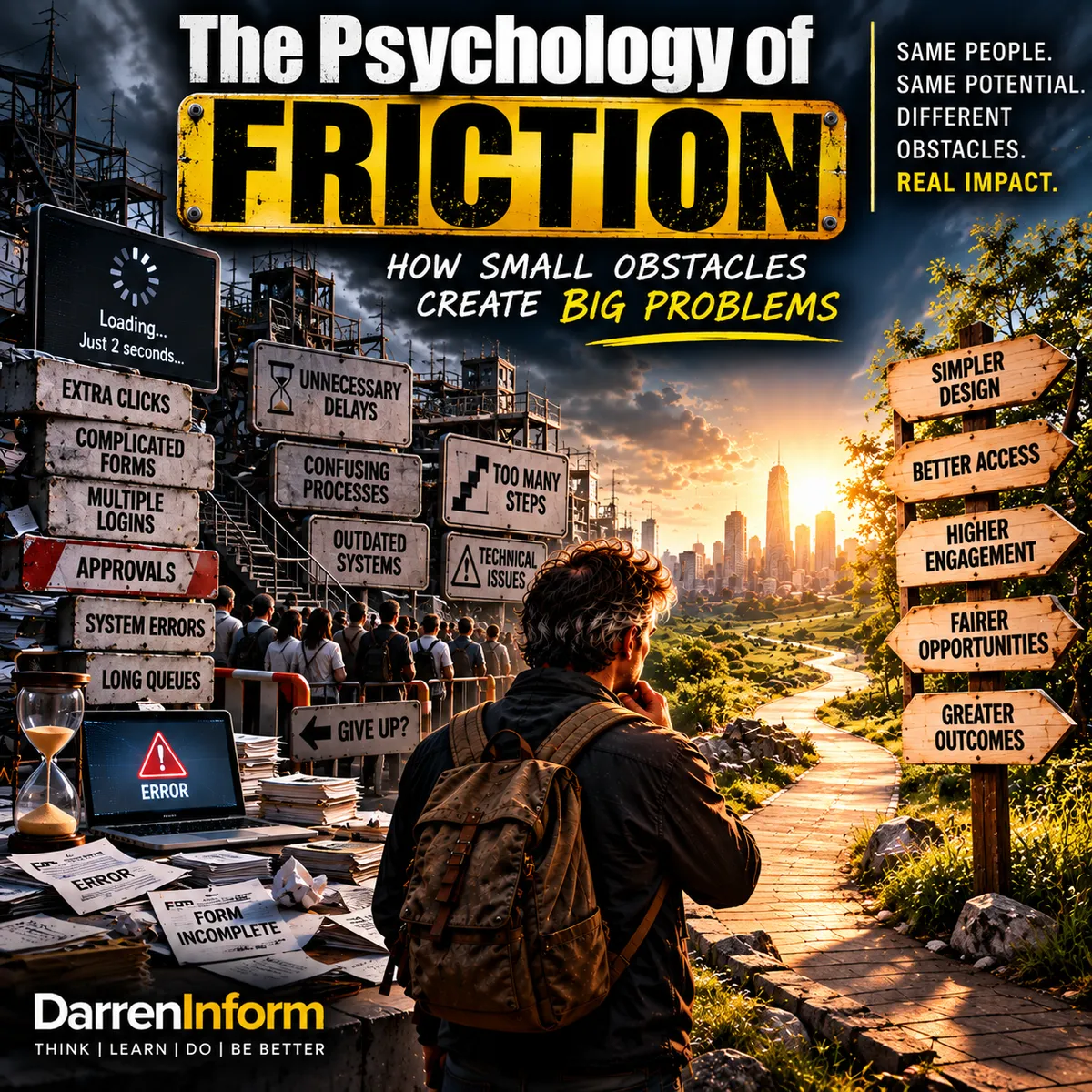
The Psychology of Friction
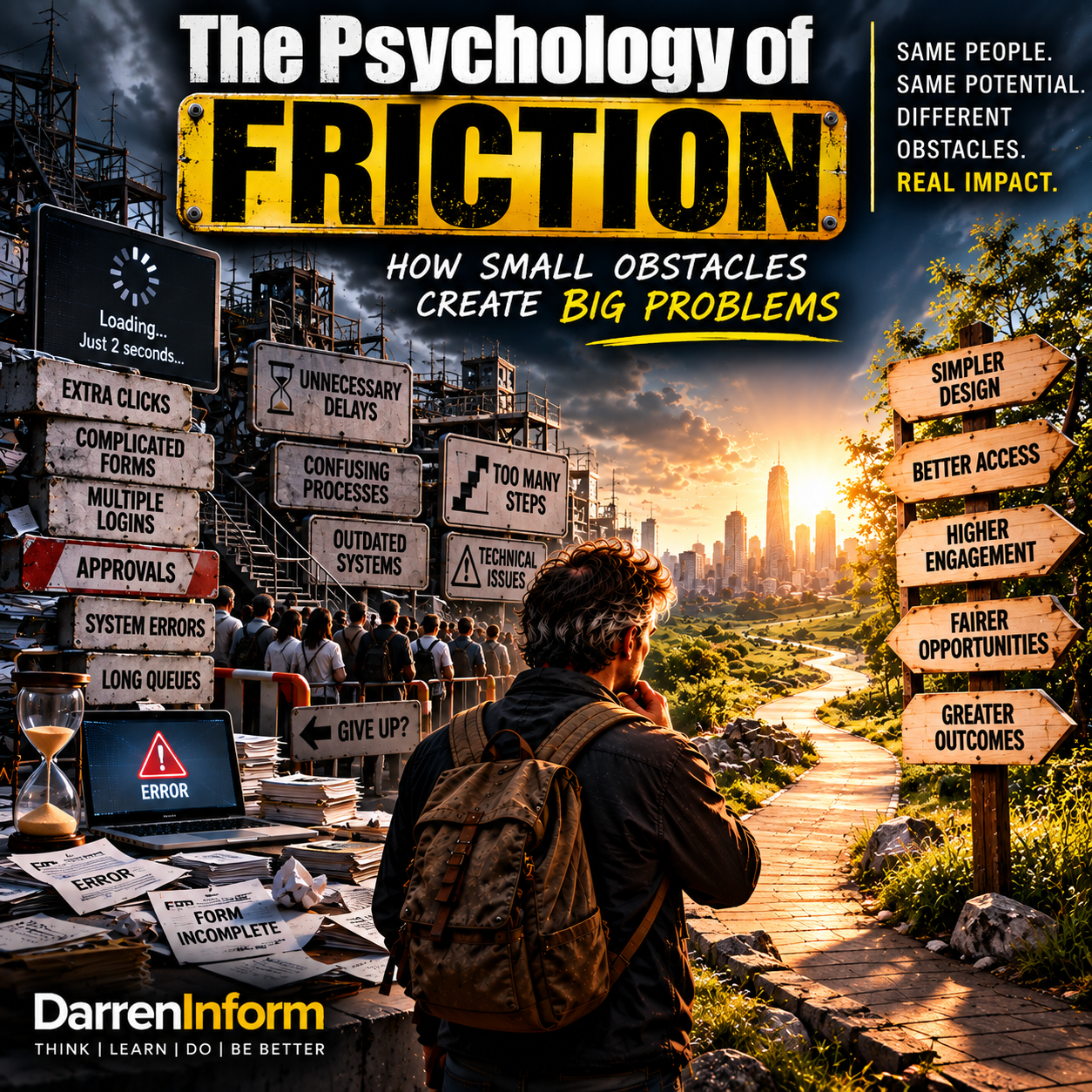
The Psychology of Friction
How Small Obstacles Create Big Problems
Have you ever abandoned something because it was just too much trouble?
Not because it was particularly difficult.
Not because you weren't interested.
Not even because you didn't want to do it.
But because the process of actually doing it became so unnecessarily irritating that, eventually, you thought:
Oh, sod it.
Perhaps it was an online form that kept resetting.
A website that took forever to load.
An application that demanded information you'd already supplied.
Or a supposedly simple task at work that required navigating six different systems, three approvals and somebody called Dave who only works Thursdays.
Individually, none of these obstacles seems particularly significant.
A few seconds here. An extra click there. Another form. Another delay.
But here's the interesting thing.
Small obstacles don't always produce small consequences.
And some fascinating new research suggests that even delays measured in seconds can make a meaningful difference to what people actually achieve.
The Problem With Two Seconds
A study published in Nature Human Behaviour on 8 October 2026 examined something the researchers called microdelays.
These are brief loading delays during online learning.
Not lengthy system failures.
Not an internet connection disappearing for half an hour.
We're talking about delays as short as one or two seconds.
The researchers examined two large groups.
The first involved 26,707 American school students using an online mathematics learning system.
The second involved 55,184 aspiring coders, primarily in Latin America, using an online coding education platform.
And they found that these apparently insignificant delays were associated with meaningful differences in learning behaviour.
School students experiencing microdelays completed fewer assignments, took longer to finish them, were more likely to become distracted and achieved lower scores.
The aspiring coders spent less time actively engaged, multitasked more, completed fewer lessons and were less likely to reach an important course milestone.
The researchers used changes in loading times experienced by the same individuals to strengthen their interpretation that the delays themselves contributed to these outcomes.
Think about that.
One or two seconds.
Not a lack of intelligence. Not necessarily a lack of motivation. Not a refusal to learn.
A tiny piece of friction built into the environment in which learning was taking place.
And that raises a much bigger question. How much human potential gets lost because we've made worthwhile things unnecessarily difficult to do?
Friction Is More Than Wasted Time
We tend to think about delays in terms of time.
If a website takes two seconds longer to load, we've lost two seconds.
No great tragedy.
But that assumes the only thing affected is the clock.
Human attention doesn't necessarily work like that.
Imagine you're concentrating on solving a problem.
You complete one step.
You click to continue.
And...
Nothing.
For a second.
Perhaps two.
Your attention drifts.
You notice a message.
You glance at another tab.
You remember something else you need to do.
And suddenly you're no longer working on the original problem.
The delay hasn't merely consumed two seconds.
It has created an opportunity for your attention to go somewhere else.
And getting it back may require considerably more effort than the original delay.
That's one plausible way to understand the research findings, although the study doesn't establish that every microdelay causes precisely this sequence.
The broader point is that friction can interrupt the continuity of an activity, not simply slow its completion.
And continuity matters.
Especially when we're learning, thinking, solving problems or doing anything requiring sustained concentration.
The Hidden Cost of Getting Started Again
There's another aspect of friction that I think we overlook.
Motivation isn't necessarily a constant resource.
Sometimes we're enthusiastic. Sometimes we're tired. Sometimes we're anxious. Sometimes we're dealing with a dozen other things. And sometimes we've got just enough energy to get started.
Now imagine that the thing we're trying to do places an unnecessary obstacle in our way.
Another password. Another verification code. Another page. Another unexplained error. Another instruction.
Perhaps we persist.
Perhaps we don't.
And when we don't, the explanation often becomes:
They weren't sufficiently motivated.
But perhaps motivation wasn't the original problem.
Perhaps the system simply demanded more of it than was necessary.
A badly designed process can turn willingness into abandonment.
That's a useful thought for anyone designing a product, managing a team, running a public service or trying to change their own behaviour.
The Inequality Hidden Inside Inconvenience
Now here's where things become particularly important.
Not everybody experiences friction in the same way.
Imagine two people trying to complete an online application. One has a modern laptop, reliable broadband, a quiet room and plenty of time. The other is using an older phone, has an unreliable connection, is juggling caring responsibilities and has limited time before returning to work.
Both encounter exactly the same poorly designed form.
But they don't necessarily experience the same cost.
For one, it's an irritation.
For the other, it may be the difference between completing the application and abandoning it.
And that's where friction becomes more than a usability problem.
It can become an access problem.
The microdelays study specifically raises concerns about learners with slower internet connections. It does not, by itself, establish the full social distribution of these effects or prove that the delays widened socioeconomic inequality.
But the wider systems implication is worth examining.
When we design processes around the assumption that everybody has abundant time, reliable technology, energy and flexibility, we risk creating barriers that fall disproportionately on those who have the least of those resources.
And then we wonder why some people participate less. Why some opportunities go unused. Why some services are difficult to access. Why some people don't complete training.
Perhaps the problem isn't always that people lack ambition or ability.
Perhaps we've made participation unnecessarily expensive.
Not necessarily in money.
But in time, attention, energy and persistence.
The Organisational Friction Factory
And now, inevitably, we arrive at the workplace.
Because organisations can be remarkably talented at creating friction.
Usually without intending to.
A process gets introduced to solve a problem. Then another process is introduced to control the first. Then somebody adds a reporting requirement. Then a new system arrives. Then an approval stage. Then a meeting to review the approvals. And eventually a task that should take ten minutes requires half a day and the patience of a Buddhist monk.
The extraordinary thing is that every individual addition may have seemed perfectly reasonable.
But nobody has examined what happens when they're all put together.
That's systems thinking territory.
A collection of individually sensible decisions can produce a collectively ridiculous process.
And when employees become frustrated, slow down or disengage, what do we do?
We look at their performance.
Perhaps they need training. Perhaps they need motivation. Perhaps they need to become more productive. But what if they already know what to do? What if they're perfectly willing to do it? What if the organisation has simply made doing it unnecessarily difficult?
We've talked recently in ThinkWORKS about the danger of trying to fix the person when the system is producing the problem.
Friction is another example.
Before asking why people aren't doing something, perhaps we should ask:
How difficult have we made it for them to do it?
Public Services and the Price of Persistence
Now apply the same thinking to public services.
Imagine somebody trying to arrange a medical appointment. Apply for support. Access training. Report a problem. Renew a document. Or obtain information they're entitled to receive.
If the process is confusing, slow or repeatedly interrupted, some people will persist.
Others may struggle.
And some will give up.
It's tempting to interpret completion rates as evidence of motivation or demand.
But that can be misleading.
A person who abandons a difficult application hasn't necessarily decided the service isn't valuable.
They may simply have reached the limit of what they can reasonably manage.
And the people least able to tolerate unnecessary friction may be precisely those who most need the service.
This is an extension of the systems principle suggested by the research, rather than a direct finding from the online-learning study.
But it's a question public-service designers ought to take seriously.
Access isn't just about whether a service exists. It's about whether people can realistically get through the process of using it.
But Friction Isn't Always Bad
Now, before we declare war on every pause, password and extra click, there's an important distinction.
Sometimes friction is useful.
We might deliberately make an impulsive purchase more difficult. Introduce a pause before posting something emotionally charged online. Require confirmation before deleting important information. Put safeguards around sensitive decisions. Or create a little distance between an immediate impulse and an action we may later regret.
In those situations, friction can be protective.
Indeed, I've explored this in Conspiracy, particularly when discussing how digital environments are designed to capture attention and encourage immediate reactions.
Sometimes a little resistance is exactly what we need.
So the goal isn't to eliminate friction everywhere.
It's to distinguish between friction that protects us and friction that obstructs us.
A useful question is:
Does this obstacle serve the person — or merely the process?
Because a pause that prevents a costly mistake may be valuable.
A pause that repeatedly interrupts somebody trying to learn may be harmful.
Same broad design principle.
Very different consequences.
Design the Behaviour, Not Just the Instruction
Here's something that connects directly with the wider ThinkWORKS philosophy.
We spend an enormous amount of time telling people what they should do.
Be more productive. Learn new skills. Take responsibility. Improve your health. Use digital services. Collaborate. Think creatively. Adapt.
But instructions don't exist in isolation.
People act within environments.
And those environments can make behaviour easier or harder.
If you want somebody to complete training, make the training accessible.
If you want employees to collaborate, remove the unnecessary obstacles between them.
If you want customers to use a service, make the process understandable.
If you want people to concentrate, stop interrupting them.
And if you want somebody to develop a new habit, make the first step easier to take.
Sometimes improving behaviour isn't about increasing motivation.
It's about reducing the amount of motivation the behaviour requires.
That's a very different way of approaching change.
And potentially a much more useful one.
Try a Friction Audit
So here's something you can do this week.
Pick one activity that people regularly struggle to complete.
It might be a task at work. A customer process. A personal habit. A training programme. Or something in your everyday life. Then follow the process from beginning to end.
Not as the person who designed it.
As somebody who has to use it.
Ask yourself:
Where do people have to wait?
Where do they have to repeat something?
Where do they have to make an unnecessary decision?
Where might their attention be interrupted?
What assumptions are we making about their time, technology, knowledge or resources?
And which of these obstacles actually serves a useful purpose?
Then choose just one unnecessary obstacle and remove it.
Not necessarily a grand redesign.
Not a six-month transformation programme.
One small improvement.
One fewer form.
One clearer instruction.
One less approval.
One faster page.
One easier first step.
Then see whether more people complete the activity, whether it takes less effort, or whether the outcome improves.
Because sometimes small changes to the environment produce meaningful changes in behaviour.
The Small Things Aren't Always Small
We often imagine that meaningful change requires a major intervention.
A new strategy.
A transformation programme.
A training initiative.
A cultural revolution.
And sometimes it does.
But this new research is a reminder that tiny design features can influence what people do, how long they persist and what they achieve.
A second or two might not sound important.
Until those seconds repeatedly interrupt learning.
An extra form might not sound important.
Until it prevents somebody accessing support.
Another approval might not sound important.
Until it stops people doing their jobs effectively.
And an additional obstacle might not sound important.
Until it becomes the reason somebody gives up.
So perhaps we need to become better at noticing the little things that make worthwhile activities unnecessarily difficult.
Because human behaviour isn't simply a product of intention.
It's also shaped by the environment in which intention has to become action.
And sometimes, before asking people to try harder, we should ask a much more useful question:
What have we made harder than it needs to be?
Because the smallest obstacle can sometimes stand between a person's willingness to act...
and their ability to succeed.
Inspired by Mazar and colleagues, “Microdelays disrupt online learning”, published in Nature Human Behaviour, 8 October 2026. The organisational and public-service examples above are wider systems-thinking applications of the research, not additional findings from the study.
Coming up on ThinkWORKS: The Psychology of Friction — why seemingly insignificant obstacles can have surprisingly large consequences, and how designing better environments can help people think, work and achieve more effectively.
