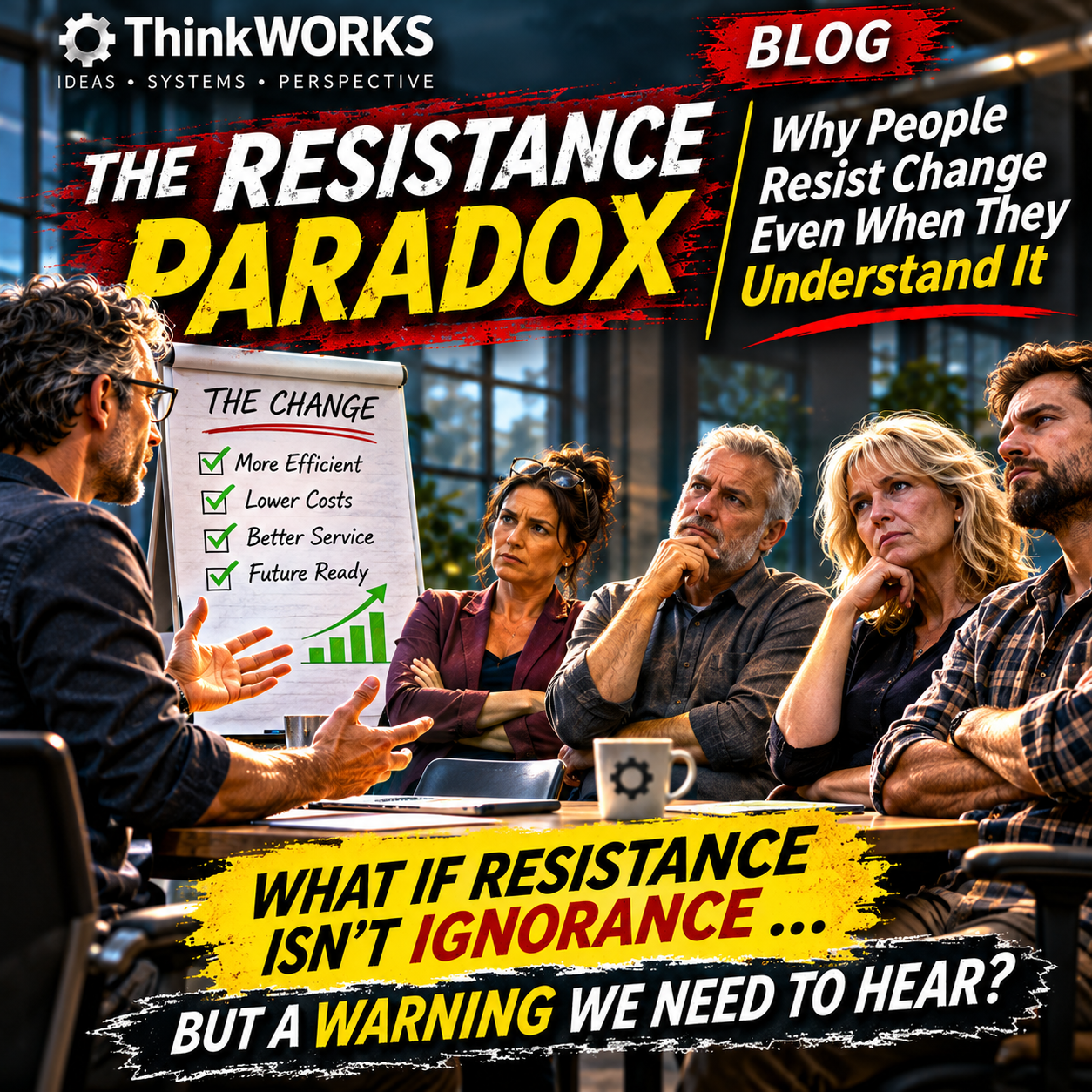
The Resistance Paradox: Why People Resist Change Even When They Understand It
The Resistance Paradox: Why People Resist Change Even When They Understand It
We often assume that people resist change because they don't understand it. But what if they understand it perfectly well — and the problem lies in the change itself, or the system being asked to accommodate it?
By Darren Smithson | ThinkWORKS
We've all encountered them.
The people who seem determined to resist change.
You introduce a new procedure, and they complain.
You suggest a better way of doing something, and they explain why it won't work.
You propose modernising an outdated system, and somebody immediately starts talking about how things were better before.
And sooner or later, somebody says those familiar words:
"People just don't like change."
Really?
I'm not convinced.
People change things voluntarily all the time.
We change jobs, move house, learn new skills, buy new technology, develop new interests and completely rearrange our lives.
Some people positively thrive on change.
So perhaps the problem isn't that people inherently dislike change.
Perhaps it's that people don't necessarily like the changes other people want to impose upon them.
And there's an important difference.
Because when we describe someone as resistant to change, we're often making an assumption about their motivation.
We assume they don't understand the benefits.
We assume they're afraid.
We assume they're stuck in their ways.
Or, if we're feeling particularly uncharitable, we assume they're simply being difficult.
But what if they understand the proposal perfectly well?
What if their objections are based on experience, competing responsibilities or consequences that the people proposing the change haven't considered?
What if resistance is telling us something important about the system itself?
Welcome to the resistance paradox.
The Great Management Assumption
There's a familiar pattern in organisational change.
Management identifies a problem.
A solution is developed.
A new system, process or working practice is announced.
Employees raise concerns.
Management concludes that the workforce doesn't understand the benefits.
So what happens next?
More communication.
Another presentation.
Another email.
Another training session.
Perhaps a carefully designed campaign explaining why everyone should embrace the exciting new future.
And when resistance continues?
Well, clearly people still don't understand.
So management explains it again.
Sometimes more forcefully.
But there's a fundamental problem with this approach.
It assumes that disagreement is evidence of misunderstanding.
And that simply isn't true.
Two people can understand exactly the same proposal and reach entirely different conclusions about whether it's a good idea.
Not because one is intelligent and the other isn't.
Not because one is progressive and the other is backward-looking.
But because they're evaluating the proposal from different positions within the system.
And those positions matter.
What Fifteen Years of Digital Transformation Can Teach Us
An interesting study published in the Information Systems Journal in November 2026 examined fifteen years of digital transformation within a Swedish municipality.
Rather than presenting organisational transformation as a straightforward progression from an outdated system to a modern one, the research examined how change unfolded through recurring institutional tensions.
Technology interacted with established professional values, authority structures and everyday working practices.
Change involved processes of consolidation, control and negotiation.
It wasn't simply a matter of introducing a better tool and waiting for everyone to recognise its advantages.
Now, this is important.
Because organisations often talk about change as though it were a technical exercise.
Identify the problem.
Select the solution.
Implement the solution.
Measure the improvement.
Job done.
But organisations aren't simply collections of processes and technologies.
They're social systems.
They're made up of people with different responsibilities, experiences, incentives, priorities and ideas about what constitutes good work.
And a change that makes perfect sense from one perspective may create serious difficulties from another.
The Swedish study offers a useful reminder that institutional transformation is not necessarily linear.
It can involve repeated negotiation between competing purposes and established practices.
And that means resistance deserves investigation rather than automatic dismissal.
The Same Change, Different Consequences
Let's imagine a hospital introducing a new digital administration system.
Senior management sees an opportunity to improve efficiency.
The finance department anticipates savings.
The technology team welcomes better integration.
From their perspectives, the proposal makes sense.
But what about the people using the system every day?
A nurse may worry that the new process will increase the time spent entering information.
A doctor may be concerned about how it affects clinical judgement.
An administrator may identify a practical problem that wasn't apparent during the design process.
And a patient may experience consequences that nobody considered.
Now, some of those concerns might prove unfounded.
Others might reveal genuine weaknesses in the proposal.
But here's the crucial point.
Understanding the intended benefits of a change doesn't mean agreeing that those benefits outweigh its costs.
And those costs may not be distributed equally.
One department might become more efficient because another department is now doing additional work.
Management might gain better performance data while employees lose valuable time completing new reporting requirements.
The organisation might save money while customers experience a poorer service.
From a distance, the change looks like progress.
From another position within the system, it looks considerably less attractive.
So when someone resists, perhaps the first question shouldn't be:
"Why won't they accept the change?"
Perhaps it should be:
"What are they seeing that we're not?"
Resistance as Information
This is where systems thinking becomes particularly useful.
In a complex system, the behaviour of one part is influenced by its relationship with the others.
Change one process, and you may create consequences elsewhere.
Alter a performance target, and people may adjust their behaviour in unexpected ways.
Introduce a new technology, and established responsibilities may suddenly become unclear.
And when people resist, that resistance may be providing information about those relationships.
Think of a car's dashboard.
If a warning light appears, you don't necessarily solve the problem by covering it with tape.
The light is telling you something.
It might indicate a minor issue.
It might indicate something serious.
It might even be a faulty sensor.
But you investigate before deciding what to do.
Organisational resistance can work in a similar way.
It isn't automatically evidence that the proposed change is wrong.
But neither is it automatically evidence that the people resisting are wrong.
It may be a signal that something important hasn't been understood.
And treating every objection as a problem to overcome can mean ignoring precisely the information needed to make the change successful.
But Let's Not Romanticise Resistance
Now, before we get carried away, there's another side to this.
Not all resistance is constructive.
Sometimes people resist because they're frightened of losing status.
Sometimes they're protecting privileges.
Sometimes they dislike uncertainty.
Sometimes they've become comfortable with arrangements that benefit them, even when those arrangements disadvantage others.
And yes, sometimes people are simply being obstructive.
I've written before about the difficulties caused by individuals who undermine organisations for their own reasons.
We shouldn't pretend those people don't exist.
But we also shouldn't assume that everyone who disagrees with a proposed change belongs in that category.
There's an important distinction between understanding resistance and endorsing it.
We can investigate why someone objects without automatically accepting their argument.
And we can recognise legitimate concerns without giving every individual an absolute veto over improvement.
Effective change requires judgement.
It means listening carefully, examining evidence, making decisions and accepting that some disagreements won't disappear.
The objective isn't to eliminate all resistance.
It's to distinguish between resistance that reveals a genuine problem and resistance that must ultimately be managed.
When the System Rewards Standing Still
There's another dimension to all this.
Sometimes resistance isn't primarily about individual attitudes.
It's about the incentives built into the organisation.
Imagine a company that announces it wants employees to innovate.
Management encourages people to challenge established procedures, experiment with new ideas and suggest improvements.
Wonderful.
But what happens when an experiment fails?
The employee is criticised.
Their performance review suffers.
Their manager demands to know why they departed from the established procedure.
Meanwhile, employees who continue doing things the traditional way receive favourable assessments.
Now, the organisation says it wants innovation.
But its incentives reward conformity.
What behaviour should we expect?
Probably not innovation.
And if employees appear reluctant to embrace change, is that necessarily because they're resistant personalities?
Or have they learned that the safest response is to keep doing what they've always done?
People respond not only to what organisations say they value, but also to what their systems actually reward.
And this is where institutional inertia becomes particularly powerful.
Established processes create established responsibilities.
Responsibilities become linked to authority.
Authority becomes linked to budgets, status and professional identity.
Over time, changing a process may mean changing much more than the process itself.
It may challenge the arrangements through which the organisation operates.
None of this requires a secret conspiracy.
It doesn't even require anyone to be deliberately obstructive.
People can be acting rationally within their own circumstances while collectively maintaining a system that isn't working particularly well.
And that should give us something to think about.
The Personal Resistance Paradox
Of course, resistance to change isn't confined to organisations.
We encounter it in our own lives.
Perhaps you've decided to develop a healthier routine.
You know why it matters.
You understand the potential benefits.
But you struggle to make the change.
Does that mean you're lazy?
Not necessarily.
Perhaps your existing routine is built around responsibilities that make the proposed change difficult.
Perhaps you're exhausted.
Perhaps the change feels overwhelming.
Or perhaps the advice you've received doesn't fit your circumstances.
This is something I explore in You 2.0: Build Yourself Better.
Personal development isn't simply about telling ourselves what we ought to do.
It's about understanding the conditions that influence what we actually do.
Our habits, expectations, environments and relationships all matter.
And sometimes the behaviour we're trying to change serves a purpose we haven't properly recognised.
For example, someone who procrastinates may not simply lack discipline.
They may be avoiding a task associated with uncertainty, criticism or an unrealistic expectation of perfection.
Someone reluctant to change jobs may not lack ambition.
They may value stability because other people depend on their income.
Someone unwilling to abandon an established routine may not be afraid of progress.
They may be protecting something genuinely important in their life.
Again, none of this means every reluctance is justified.
But it does mean that understanding behaviour requires more than attaching a label to it.
The Difference Between Persuasion and Participation
So what should we do when people resist change?
Well, perhaps we should begin by reconsidering how change is developed.
Too often, organisations design solutions and then involve employees primarily to persuade them to accept those solutions.
Participation becomes a communication exercise.
The important decisions have already been made.
People are invited to comment, but not necessarily to influence the outcome.
And then management wonders why employees don't feel any ownership.
But genuine participation is different.
It means involving people while the problem is still being defined.
It means asking what consequences a proposed intervention might create.
It means recognising that those closest to the work may possess knowledge unavailable to senior decision-makers.
And it means being prepared to change the proposal when the evidence warrants it.
That doesn't mean every decision must be made by committee.
Leadership still matters.
Decisions still have to be taken.
But there's a significant difference between involving people in developing a workable solution and merely explaining why they should accept one.
People are more likely to contribute meaningfully to change when their experience is treated as information rather than an obstacle.
From Resistance to Better Questions
So perhaps we need to change the questions we ask.
Instead of asking why people won't embrace change, ask what the proposed change means from their perspective.
Instead of assuming that more communication will solve the problem, ask whether there are genuine disagreements about priorities or consequences.
Instead of labelling people as difficult, examine the incentives influencing their behaviour.
And instead of assuming that the original proposal must be right, consider what the resistance might reveal about its weaknesses.
This is not an argument for abandoning change.
It's an argument for understanding the system we're trying to change.
Because progress requires more than a good idea.
It requires an appreciation of the relationships, responsibilities and constraints that determine whether that idea can work in practice.
Your ThinkWORKS Challenge
Here's something to try this week.
Think about a change you've encountered recently.
It might be at work.
It might involve your family.
Or it might be something you've been trying to change in your own life.
Now ask yourself three questions.
1. What is the change supposed to improve?
Be clear about its intended benefits.
2. Who might experience the change differently — and why?
Consider the costs, risks, responsibilities and priorities that may not be obvious from your own perspective.
3. What could the resistance teach us?
Is it revealing a genuine problem with the proposal?
An incentive that needs changing?
A practical obstacle?
Or perhaps a concern that needs addressing before progress becomes possible?
You may still conclude that the change is necessary.
You may still have to make a difficult decision.
But you'll be making it with a better understanding of the system involved.
And that's rarely a bad thing.
The Real Paradox
We began with a familiar assumption.
People resist change because they don't understand it.
But perhaps the truth is considerably more interesting.
Sometimes people resist because they understand the consequences better than the people proposing the change.
Sometimes they resist because the system rewards existing behaviour.
Sometimes they resist because the proposed improvement threatens something valuable.
And sometimes, of course, they resist for reasons that have very little to do with the merits of the proposal.
The challenge is knowing the difference.
Because resistance isn't automatically wisdom.
But neither is it automatically ignorance.
And if we want to build better organisations, develop better habits and create more effective systems, we need to stop treating every objection as a failure of understanding.
Sometimes the people saying no are protecting the past.
But sometimes they're identifying the problem that everybody else has overlooked.
The trick is learning to tell the difference.
And perhaps the next time somebody resists a change, instead of immediately asking how to overcome their objections, we should begin with a simpler question.
"What do they know that I don't?"
ThinkWORKS explores the ideas, systems and assumptions that shape how we think, work and live. Because better thinking should lead to better systems — and ultimately, better lives.
Research and further reading
Navigating institutional friction in digital transformation — Information Systems Journal, 11 November 2026.
https://onlinelibrary.wiley.com/doi/10.1111/isj.70070
Transdisciplinary spaces for co-production — npj Climate Action, 10 November 2026.
https://www.nature.com/articles/s44168-026-00443-6
Research note: The studies inform the discussion of institutional friction, competing priorities and collaborative transformation. The workplace scenarios, personal development examples and broader arguments about incentives are ThinkWORKS interpretations, not direct empirical findings from these studies.
#ThinkWORKS #SystemsThinking #OrganisationalChange #Leadership #PersonalDevelopment
