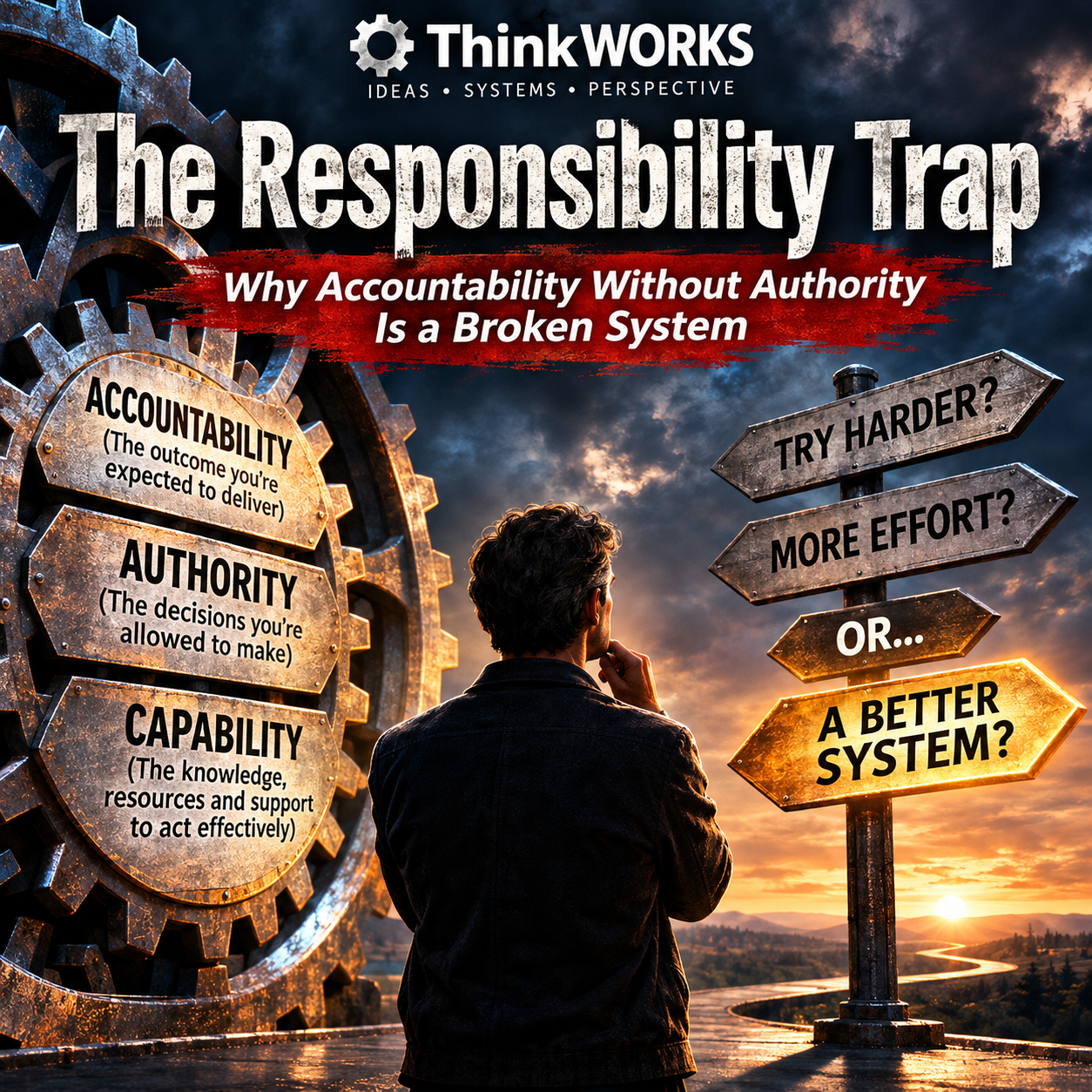
The Responsibility Trap: Why Accountability Without Authority Is a Broken System
The Responsibility Trap: Why Accountability Without Authority Is a Broken System
We tell people to take responsibility for their lives, their work and their decisions. But what happens when the systems around them make meaningful responsibility almost impossible?
By Darren Smithson | ThinkWORKS
We live in a world that loves the language of responsibility.
Take ownership. Be accountable. Show initiative. Make better decisions. Take control of your future.
They're familiar instructions, and on the surface, perfectly reasonable ones.
After all, personal responsibility matters. Without it, we risk becoming passive observers of our own lives, forever waiting for someone else to solve our problems.
But there's something missing from the conversation.
Responsibility only becomes meaningful when people have the ability to exercise it.
And increasingly, I'm beginning to wonder whether we've built organisations, institutions and even social expectations that demand accountability while quietly removing the conditions necessary to achieve it.
It's a contradiction worth exploring.
The Human in the Loop
Some recent research into artificial intelligence has revealed an interesting problem.
In healthcare, AI systems are increasingly being used to assist professionals with interpreting information and making decisions.
Naturally, one of the safeguards is human oversight.
The technology makes a recommendation. A qualified human examines it. The human retains responsibility for the final decision.
Simple enough.
Except that the research suggests things aren't quite so straightforward.
One study examining AI-assisted diagnostic decisions found that medical trainees accepted 52% of deliberately incorrect AI suggestions presented during the experiment.
Another systematic review found that clinicians were considerably more effective when automated recommendations were correct than when they were wrong. Across four real-world ECG studies, an estimated 26.6% of erroneous automated interpretations went unrecognised or uncorrected.
These findings don't mean human oversight is pointless, nor do they establish that every AI-assisted decision is unsafe.
They reveal something more subtle.
Having a human involved in a decision does not automatically mean that human can exercise effective control over it.
That depends on their expertise, the information available, the design of the technology, their workload, and whether the surrounding organisation genuinely enables them to question what they're being told.
Simply placing someone in the loop isn't enough.
And while these studies concern particular medical settings, I think the underlying question deserves much wider attention.
Because how often do we see similar problems elsewhere?
The Illusion of Workplace Accountability
Imagine you're managing a department.
You're responsible for meeting performance targets, keeping your team motivated, maintaining quality and delivering results.
Sounds reasonable.
Except you don't control staffing levels.
You can't change the budget.
You have little influence over the technology your team must use.
Your targets are determined by people who rarely experience the realities of your department.
And when something goes wrong, you're expected to explain why you didn't prevent it.
Welcome to the responsibility trap.
It's a situation in which someone is held accountable for outcomes without having sufficient authority over the conditions that produce them.
Of course, managers and employees still have choices. They can communicate, prioritise, adapt and challenge decisions.
But there's a limit to what individual initiative can achieve when the wider system repeatedly works against it.
And this creates a particularly damaging organisational habit.
We begin treating systemic problems as individual performance failures.
A team misses its targets, so we demand greater effort.
A project falls behind, so we question people's commitment.
An employee becomes overwhelmed, so we recommend resilience training.
Sometimes those responses are appropriate.
But sometimes they're simply easier than examining the processes, incentives and decisions that created the problem in the first place.
And if we continually ask people to compensate for dysfunctional systems, we shouldn't be surprised when they eventually become exhausted, disengaged or cynical.
When Responsibility Becomes a Convenient Excuse
There's another dimension to this problem.
Accountability can become a remarkably convenient way for organisations to protect themselves.
Consider a workplace where employees are told they have the freedom to challenge poor decisions.
There's an open-door policy. A feedback mechanism. Perhaps even an anonymous suggestion system.
On paper, everything looks wonderfully democratic.
But what happens when someone actually challenges a decision?
Are they listened to?
Do they receive a reasoned response?
Can they question senior management without damaging their prospects?
Does anything change?
Or does the organisation quietly reward compliance while publicly celebrating independent thinking?
The difference matters.
A system can appear to encourage responsibility while creating powerful incentives not to exercise it.
Nobody needs to issue an explicit instruction to remain silent.
People learn which behaviours are rewarded and which create difficulties.
Over time, the system begins producing predictable patterns of behaviour.
And this is one of the central ideas I've been exploring while working on my second book, Conspiracy.
We often look for individuals to blame when outcomes are poor.
But sometimes the more revealing question is not who made the decision.
It's what conditions made that decision likely in the first place.
The Personal Responsibility Paradox
Now, before anyone thinks I'm suggesting that personal responsibility doesn't matter, let me make something clear.
I believe it matters enormously.
In You 2.0, I explore how our habits, beliefs, choices and everyday systems influence the lives we build.
We cannot simply surrender our agency because circumstances are difficult.
But personal responsibility isn't the same thing as pretending circumstances don't exist.
Think about someone trying to improve their financial position.
We can encourage them to budget more effectively, develop new skills, reduce unnecessary spending and make informed decisions.
All sensible advice.
But their choices also exist within a wider environment involving wages, housing costs, employment opportunities, family responsibilities and economic conditions.
Or consider someone trying to improve their wellbeing.
We can talk about sleep, exercise, relationships and stress management.
Again, valuable things.
But what if their working arrangements, caring responsibilities or financial insecurity make those changes difficult to sustain?
The point isn't that individuals are powerless.
It's that personal agency and systemic conditions interact.
And effective change requires us to understand both.
Otherwise, we risk offering people advice that sounds empowering but doesn't address the obstacles they actually face.
Why Trying Harder Isn't Always the Answer
One of the most persistent assumptions in modern life is that greater effort produces better outcomes.
Sometimes it does.
Practice improves skills. Persistence helps overcome setbacks. Discipline allows us to achieve things that motivation alone cannot.
But effort is only one part of the equation.
Imagine trying to fill a bucket with water when there's a hole in the bottom.
You could work harder.
You could pour faster.
You could become extraordinarily disciplined about your water-carrying technique.
But sooner or later, someone needs to ask why we're not fixing the bucket.
That's systems thinking in its simplest form.
Instead of continually demanding better individual performance, we examine the structure producing the results.
What information is available?
Who makes the decisions?
What behaviours are rewarded?
Where are the bottlenecks?
What happens when something goes wrong?
And perhaps most importantly:
Are the people expected to deliver results actually equipped and authorised to do so?
These questions aren't excuses for poor performance.
They're the foundations of better performance.
AI Is Making This Question More Urgent
Artificial intelligence adds another layer to the responsibility trap.
As organisations automate more activities, human roles may increasingly shift towards monitoring, approving and intervening when something goes wrong.
But that creates an uncomfortable possibility.
What happens when people become responsible for supervising systems they no longer fully understand?
What happens when automation performs routine tasks so effectively that people lose the practice required to recognise unusual failures?
And what happens when someone is expected to challenge a machine whose recommendations are normally correct, particularly when time is short and the technology appears authoritative?
These are not arguments against AI.
They're arguments for designing better relationships between people, technology and organisations.
If we want meaningful human oversight, we need to preserve expertise, provide understandable information, create opportunities for challenge and test how systems behave when things go wrong.
Not merely appoint someone to sign off the decision.
And that raises a broader question for the future of work.
As machines become more capable, perhaps the most valuable human contribution won't always be doing more.
Perhaps it will increasingly involve judgement, questioning assumptions, recognising failures and deciding what outcomes are actually worth pursuing.
That's a question I intend to explore further in The 50 Year Horizon.
From Blame to Better Design
So where does all this leave us?
I think we need to become more precise about what we mean by responsibility.
There are at least three elements involved.
Accountability: What outcomes are you expected to answer for?
Authority: What decisions are you permitted to make?
Capability: Do you have the knowledge, resources, time and support needed to act effectively?
When those three elements are reasonably aligned, responsibility can be empowering.
When they're badly misaligned, responsibility can become a source of frustration, anxiety and blame.
And this applies just as much to our personal lives as it does to organisations.
We should absolutely encourage people to take ownership of what they can influence.
But we should also encourage them to recognise when an obstacle is structural rather than personal.
Sometimes the answer is to develop a new skill.
Sometimes it's to change a habit.
Sometimes it's to have a difficult conversation.
And sometimes it's to redesign the system itself.
The trick is knowing which problem you're actually trying to solve.
A Question Worth Asking
Here's something to consider this week.
Think about an area of your life or work where you're expected to deliver a particular outcome.
Now ask yourself:
What am I genuinely accountable for?
Which decisions can I actually influence?
What information, authority or resources am I missing?
Am I trying to overcome a structural problem through individual effort alone?
What one change would make meaningful responsibility easier?
You may discover that you have more influence than you realised.
Or you may discover that the problem you've been struggling with isn't entirely yours to solve.
Either way, that's useful knowledge.
Because the goal isn't to escape responsibility.
It's to make responsibility meaningful.
And perhaps we should stop measuring the quality of our systems by how clearly they assign blame, and start measuring them by how effectively they enable people to succeed.
After all, responsibility without the ability to act isn't empowerment.
It's a system passing the buck.
ThinkWORKS explores the ideas, systems and assumptions that shape how we think, work and live. Because better thinking should lead to better systems — and ultimately, better lives.
Further reading
Human oversight of erroneous clinical AI and decision support, npj Digital Medicine, October 2026: https://www.nature.com/articles/s41746-026-03408-5
Expertise modulates automation bias and sentinel behaviour, npj Digital Medicine, October 2026: https://www.nature.com/articles/s41746-026-03399-3
#ThinkWORKS #SystemsThinking #PersonalResponsibility #Leadership #ArtificialIntelligence #You20 #Conspiracy
