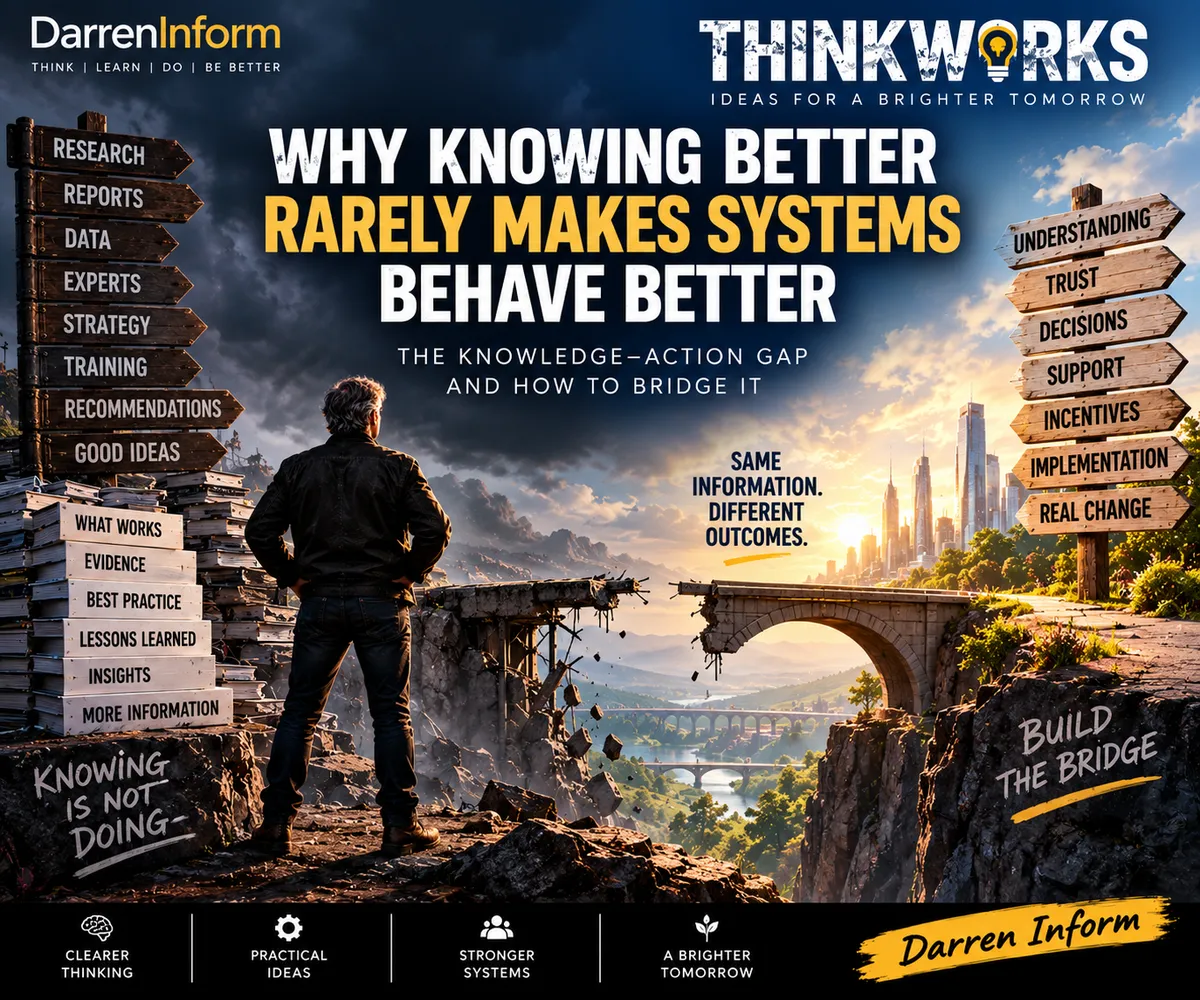
Why Knowing Better Rarely Makes Systems Behave Better
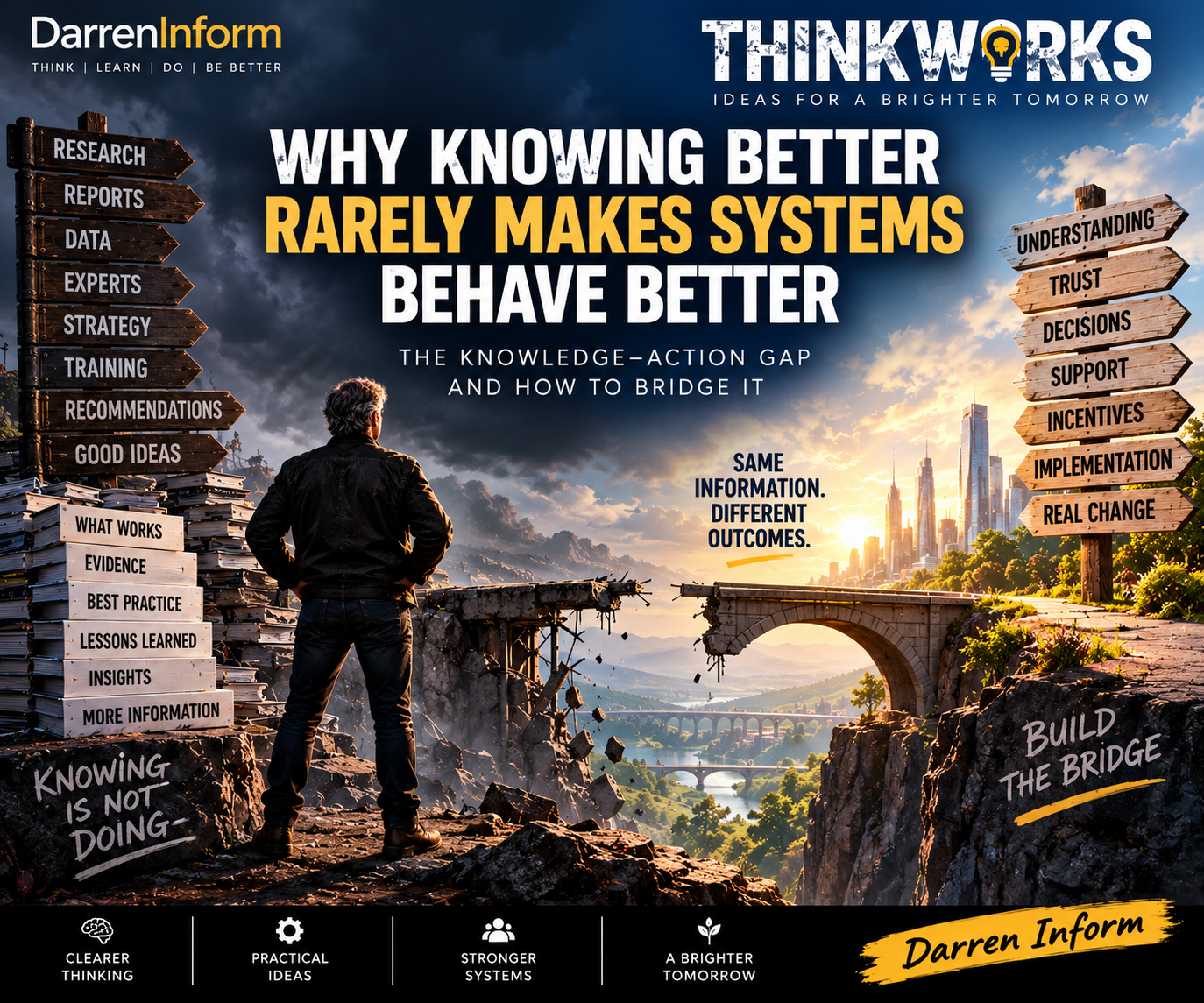
Why Knowing Better Rarely Makes Systems Behave Better
We have a comforting idea about how progress happens.
Someone discovers something.
We gather the evidence.
We work out what works.
We tell the people responsible.
And they change what they're doing.
Job done.
Except, of course, that's frequently not what happens.
Sometimes we know something for years — even decades — before organisations, institutions or individuals actually behave differently.
Which raises an interesting question.
If we know better, why don't we necessarily do better?
A new paper in Nature Human Behaviour explores exactly this problem in policymaking.
The researchers call it the production–adoption gap.
We can invest enormous amounts of time and money producing good evidence without that evidence ever substantially influencing what happens in the real world.
Their argument is that producing evidence and getting evidence adopted are different problems. Evidence has to become useful. It has to become usable. And ultimately, it has to become used.
That distinction caught my attention.
Because although the paper is about policymaking, I think the underlying question travels much further.
Knowing Isn't Doing
Think about your own organisation.
How many problems exist that nobody knows about?
Probably some.
But now ask a different question.
How many problems exist that everybody already knows about?
The meeting everybody agrees is pointless. The process everyone knows is unnecessarily complicated. The system that causes the same complaints every month. The behaviour everyone accepts is damaging morale. The customer problem that's appeared in report after report. The project that everyone privately suspects isn't working.
Nobody needs another research paper to reveal these things.
They're already known.
And yet they continue.
Why?
Because information isn't the same thing as change.
That's where I think this research becomes particularly interesting from a systems perspective.
The Missing Middle
We often imagine change as having two stages:
Knowledge → Action
But there's an enormous amount hiding inside that arrow.
Who receives the information? Do they understand it? Do they trust it? Does it arrive at the moment when a decision can actually be made? Does somebody have responsibility for doing something about it? Do they have the authority? The resources? The time? What existing procedures would have to change? What incentives encourage the existing behaviour? Who benefits from things staying as they are? What happens if acting on the evidence creates additional work?
And perhaps most importantly:
What happens next?
You can have excellent evidence sitting inside a system that is almost perfectly designed to ignore it.
The problem isn't necessarily ignorance.
The problem may be architecture.
The Training Course Problem
Here's a simple example.
Imagine an organisation discovers that its managers aren't giving staff useful feedback. So it commissions some training. The managers attend. They learn how to give better feedback. The evaluations are excellent. Everyone goes home happy.
Six months later...
very little has changed.
Our instinct is often to conclude that the training didn't work.
But perhaps that's the wrong diagnosis.
Maybe managers returned to exactly the same workload. Exactly the same targets. Exactly the same meeting culture. Exactly the same performance-management system. Exactly the same pressures. Nothing in the environment changed to make the new behaviour easier. Nothing made the old behaviour harder.
So the organisation changed what people knew... without changing the system in which they were expected to use that knowledge.
That's a very different problem.
Information Is Not Implementation
I've spent a lot of time recently talking about the fact that we're drowning in information but starving for meaning.
This research adds another layer.
Even meaning isn't necessarily enough.
We might understand the evidence perfectly. We might agree with it. We might even genuinely want to act upon it.
And still fail to change.
Because somewhere between:
“We know what we should do”
and
“This is now how we do things”
there is an implementation system.
And if that system doesn't exist, knowledge can simply pile up.
Reports. Recommendations. Lessons learned. Training programmes. Strategy documents. Employee surveys. Customer feedback. Research.
All producing more knowledge about what should happen... without necessarily changing what actually happens.
Don't Just Send the Report
So perhaps when we discover something important, we need to stop treating communication as the final step.
Instead ask:
What needs to happen for this knowledge to travel?
Who needs to understand it? Who needs to make a decision? What behaviour needs to change? What process supports that behaviour? What gets in the way? What incentives are pulling in the opposite direction? How will we know whether anything actually changed? And who owns the next step?
That's a much more demanding approach than emailing everyone a PDF.
But it's also considerably more likely to produce something useful.
Build the Bridge
Perhaps the lesson is remarkably simple.
Don't just produce knowledge. Build the route by which knowledge becomes action.
That's true in government. It's true in business. It's true in education. It's true in community organisations.
And frankly, it's true in our personal lives.
Knowing exercise is good for us isn't the same as exercising. Knowing we should save money isn't the same as saving it. Knowing a relationship needs attention isn't the same as having the conversation. Knowing what needs doing doesn't magically create the conditions in which it gets done.
There is always a bridge between understanding and behaviour.
And somebody has to build it.
So here's this week's ThinkWORKS question:
Think of one thing in your organisation — or your life — that you already know should change.
Don't ask:
“What else do I need to know?”
Ask:
“What is stopping what I already know from becoming what I actually do?”
Because perhaps the next breakthrough doesn't require another report.
Another meeting. Another course. Another expert. Or another piece of information.
Perhaps you already know enough.
Perhaps the real work is building the system that allows what you know to become what you do.
This week's ThinkWORKS was inspired by new research published in Nature Human Behaviour examining the gap between producing evidence and getting it adopted in policymaking.
On Monday's ThinkWORKS, we'll go deeper into the knowledge–action gap: why organisations can know exactly what's wrong and still keep doing it — and how we can design systems that make better behaviour more likely.
