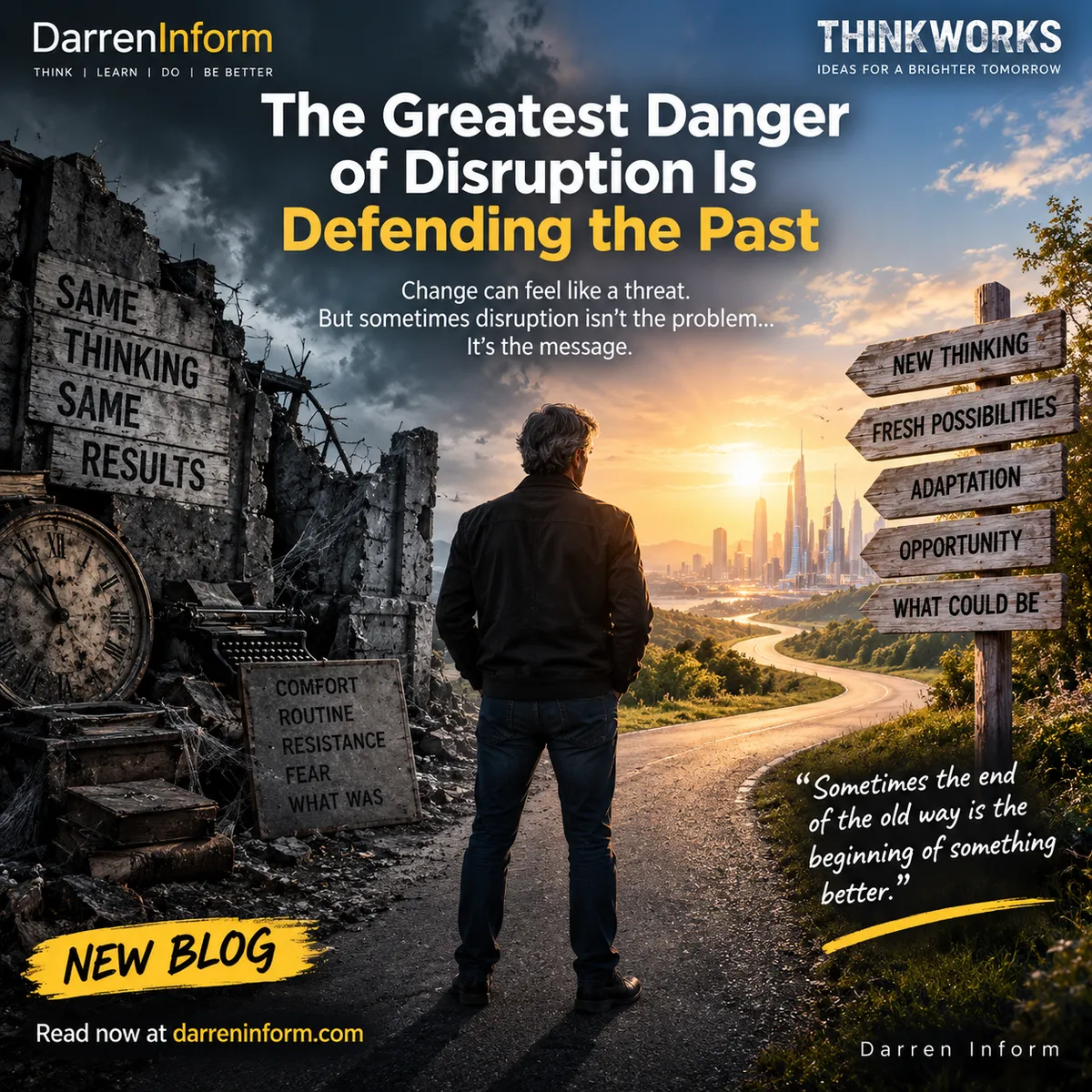
The Greatest Danger of Disruption Is Defending the Past
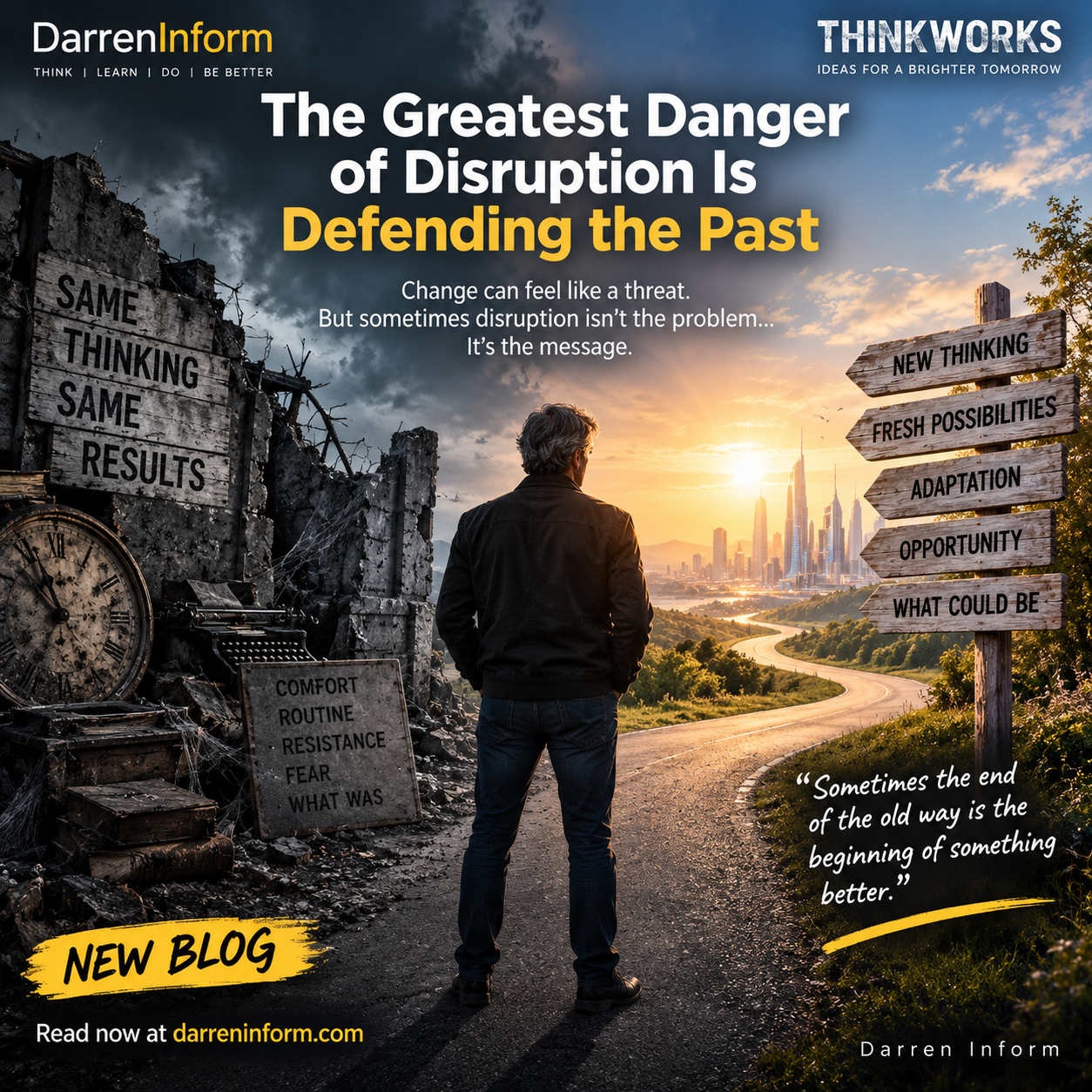
The Greatest Danger of Disruption Is Defending the Past
Change rarely introduces itself politely.
It doesn't knock on the door, wait to be invited in and give us six months to prepare.
More often, it barges straight through the wall.
A new technology appears.
A competitor changes the rules.
Customers start behaving differently.
An industry that seemed secure begins to wobble.
Something happens in our personal lives that makes the old routine impossible.
And when that happens, one of our first instincts is often:
How do we stop this?
How do we protect what we have?
How do we defend our position?
How do we get things back to normal?
It's understandable. But it may also be exactly the wrong question.
When Change Looks Like a Threat
Human beings aren't particularly fond of uncertainty.
We like familiar things because familiar things are predictable. We know how they work. We understand the rules.
And organisations are often even worse.
Over time, businesses develop processes, structures, products, hierarchies and ways of working that become part of their identity.
This is how we do things.
Eventually that can quietly become:
This is how things must be done.
Then disruption arrives.
And because the disruption threatens the existing system, we assume the disruption itself must be the problem.
But sometimes it isn't.
Sometimes disruption is simply exposing a problem that was already there.
The Dangerous Question
Imagine you've been running a successful business for twenty years.
Then a new technology appears that allows customers to get something similar to your product faster, cheaper or more conveniently.
The obvious question is:
How do we protect our existing business?
But there's another question:
What is this change telling us about what customers actually want?
Those two questions lead to very different conversations.
The first begins with the assumption that the existing business model must survive.
The second begins with curiosity.
And curiosity gives us options.
Perhaps the old model can be improved. Perhaps part of it needs replacing. Perhaps the new technology can be incorporated. Perhaps there's an entirely new market waiting to be created.
Or perhaps what appeared to be a threat contains an opportunity nobody else has noticed yet.
We Don't Just Do This in Business
This isn't only about companies.
We do exactly the same thing in our own lives.
We protect routines because they're familiar.
We hold onto jobs because they're secure.
We defend assumptions because we've held them for years.
We maintain systems because changing them would be inconvenient.
We continue doing things that no longer work particularly well because at least we understand how they work.
And then something changes.
Our instinct is to restore the old normal.
But occasionally change is telling us something rather useful:
The old normal wasn't working as well as we thought it was.
That's an uncomfortable possibility.
But it's also potentially liberating.
Threat or Opportunity?
This doesn't mean every disruption should be welcomed.
Some threats really are threats.
Some competitors need responding to.
Some technologies create genuine problems.
Some changes need resisting.
The point isn't:
Never defend what you have.
The point is:
Don't automatically defend what you have simply because you already have it.
There's an enormous difference.
Before deciding how to respond to disruption, we need to understand what the disruption has actually changed.
What has become weaker?
What has become stronger?
What assumptions no longer hold?
What new possibilities now exist?
And perhaps most importantly:
If we weren't already doing things this way, would we choose to start doing them this way today?
That's a much harder question.
AI Gives Us a Perfect Example
Artificial intelligence is currently creating exactly this conversation across dozens of industries.
The first reaction is understandably about threat.
Which jobs will disappear?
Which businesses will struggle?
Which skills will become less valuable?
Which existing systems will be disrupted?
Those are important questions.
But they're only half the conversation.
We should also be asking:
What becomes possible now that wasn't possible before?
What work could become easier?
What new businesses might appear?
What previously expensive capabilities might become accessible to small organisations or individuals?
What new skills become valuable?
And perhaps most interestingly:
What becomes more valuable precisely because AI exists?
That last question fascinates me.
Because sometimes disruption doesn't simply destroy value.
It moves value somewhere else.
The challenge is noticing where it has moved.
Try This
Think of one change currently affecting your work, business or personal life.
Especially one you don't particularly like.
Now write down your immediate response to it.
Perhaps it's:
I wish this hadn't happened.
We need to stop this.
Things were better before.
How do we protect ourselves?
Fair enough.
Now deliberately turn the question around.
Ask:
What becomes possible because this has happened?
Don't worry initially about whether the answers are practical.
Just explore.
What could you do differently?
What could you stop doing?
What assumptions could you abandon?
What might become easier?
What might become more valuable?
What opportunity might exist inside the disruption?
You may finish the exercise and still decide the threat needs fighting.
That's fine.
But at least you'll be fighting it because you've considered the alternatives and decided defence is genuinely the best strategy.
Not simply because change arrived wearing the clothes of a threat.
If You Remember One Thing...
Change doesn't care how successful your old way of doing things was.
And the strategies that created yesterday's success aren't guaranteed to create tomorrow's.
So when disruption arrives, don't begin by asking:
How do I protect the past?
Begin with:
What does this change make possible?
Because sometimes the greatest danger isn't the disruption itself. It's responding to the future by defending the past.
