
Why We Still Look Up
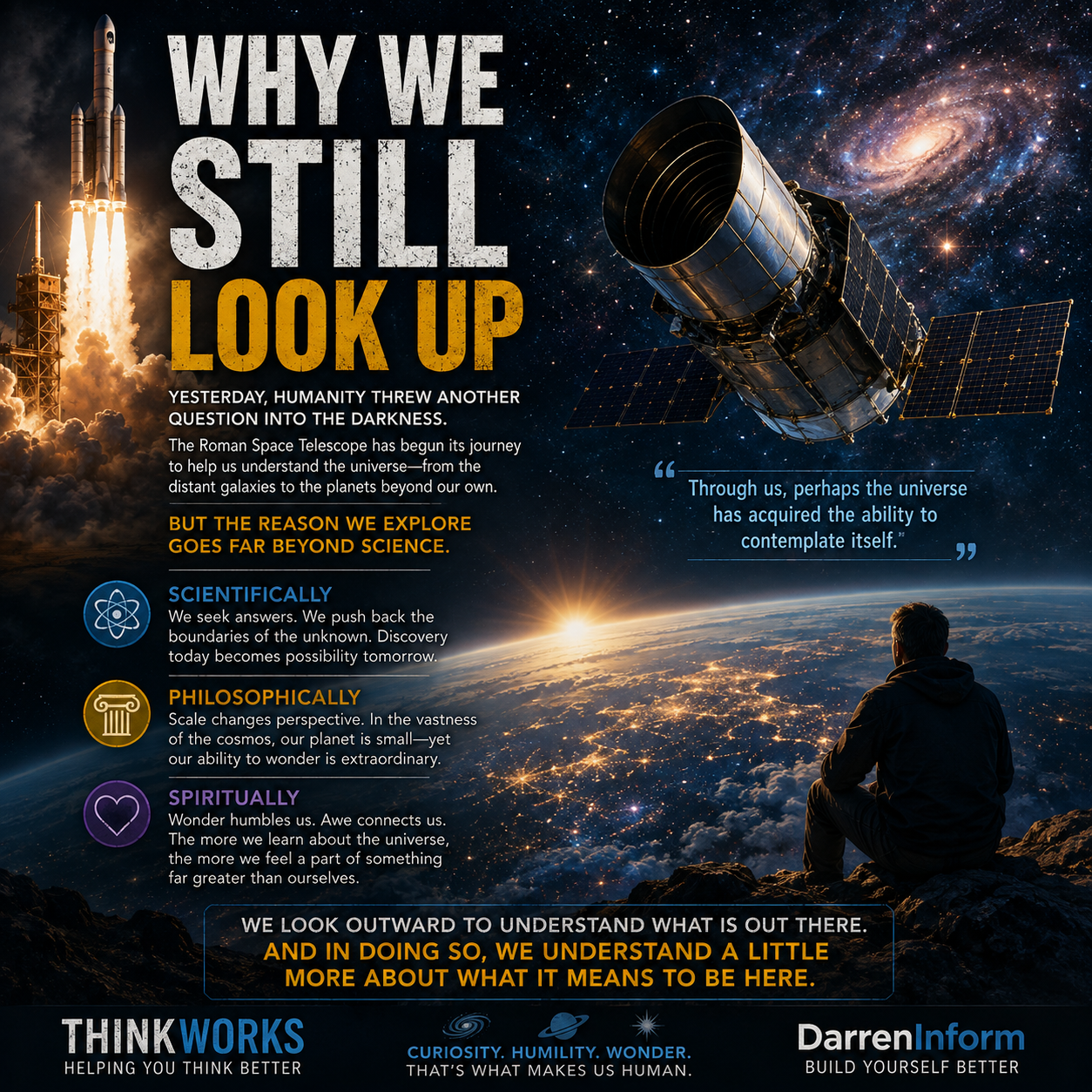
Why We Still Look Up
Yesterday, humanity threw another question into the darkness.
At 7:26 a.m. EDT on Sunday, 30 August, NASA's Nancy Grace Roman Space Telescope lifted off from Kennedy Space Center aboard a Falcon Heavy rocket. It is now beginning a journey of roughly a million miles towards its eventual home around the second Sun-Earth Lagrange point, L2. nasa.gov
It will take around three months to get there and complete its commissioning. Then, if all goes according to plan, early next year we will begin seeing the universe through a new set of eyes. nasa.gov
And quite some eyes they are.
Roman's primary mirror is the same diameter as Hubble's, but its Wide Field Instrument can capture an area of sky at least 100 times larger in a single image. Over its first five years of observations, NASA estimates that Roman will image more than 50 times as much sky as Hubble has covered in 30 years. science.nasa.gov
It will map galaxies by the billion. Hunt for planets around other stars. Study black holes. Help us investigate dark matter and dark energy — two names we have given to phenomena that appear to dominate the universe, yet which we still understand remarkably little about. science.nasa.gov
All of which is scientifically fascinating.
But watching Roman leave Earth made me think about a much bigger question.
Why do we keep doing this?
Why, when there are wars to stop, diseases to cure, economies to fix, poverty to tackle and countless other problems right here on Earth, do human beings devote extraordinary amounts of ingenuity, money and effort to staring into space?
Why do we need to know what's out there?
I think there are at least three answers.
And they tell us something rather wonderful about ourselves.
Because we need to know
The first answer is the obvious one.
Science.
Human beings have always tried to understand the world around them. We observe. We measure. We experiment. We develop explanations — and then, importantly, we try to prove those explanations wrong.
Gradually, our picture of reality becomes a little clearer.
But fundamental scientific exploration has an interesting characteristic.
We frequently don't know what it's going to be useful for when we begin.
That's almost the point.
If we only investigated questions for which we could already predict a commercial or practical return, enormous areas of human knowledge would never have existed.
Curiosity opens doors before we know what's behind them.
And Roman is very much a curiosity machine.
One of its principal tasks is investigating why the expansion of the universe appears to be accelerating. We call whatever is causing that acceleration dark energy, which sounds impressively knowledgeable until you realise that the name essentially describes something whose nature remains one of the biggest mysteries in modern cosmology.
Likewise dark matter: we can observe gravitational effects suggesting that something is there, but its underlying nature remains unknown.
Then there are the planets.
Roman is expected to help build a statistical picture of planetary systems throughout our galaxy, while its coronagraph technology will demonstrate ways of directly imaging planets around other stars by suppressing the overwhelming glare of their suns. science.nasa.gov
And that inevitably takes us towards one of the oldest questions humanity has ever asked.
Are we alone?
We don't know.
Which is precisely why we keep looking.
Because scale changes perspective
But there is another reason for exploring the universe that has nothing to do with technological spin-offs, economic returns or even scientific knowledge.
Looking outward changes the way we look inward.
Consider the scale involved.
Our Sun is one star among hundreds of billions in the Milky Way.
Our galaxy is one among an almost incomprehensible number scattered throughout the observable universe.
And somewhere inside all that vastness sits a small rocky planet on which, as far as we currently know, something extraordinary happened.
Matter became alive.
Then some of that living matter became conscious.
And eventually it became conscious enough to ask:
What is all this?
I find that thought extraordinary.
Every civilisation we have created.
Every empire.
Every war.
Every fortune ever accumulated.
Every political argument.
Every border humans have drawn across a map.
Every book ever written.
Every song ever sung.
Every person who has ever loved somebody.
All of it has happened here.
On this tiny island of life suspended within something whose scale our brains can barely comprehend.
And strangely, I don't find that diminishing.
I find it enormously affirming.
Because our physical insignificance doesn't necessarily imply that our lives are insignificant.
Quite the opposite.
Against that extraordinary cosmic backdrop, the fact that we are here at all becomes astonishing.
The atoms in our bodies were forged through cosmic processes stretching back billions of years.
And now some of those atoms are arranged into creatures capable of building telescopes, launching them into space and using them to investigate the universe from which those same atoms came.
There's something rather beautiful about that.
Perhaps, through us, the universe has acquired the ability to contemplate itself.
Because wonder matters
Which brings me to the third reason.
And it's the one we sometimes struggle to talk about.
Wonder.
We tend to divide science and spirituality into separate boxes.
Science belongs to evidence, measurement and reason.
Spirituality belongs to meaning, transcendence and our sense of connection with something larger than ourselves.
Sometimes those worlds are even presented as opponents.
I'm not sure they need to be.
Because science has repeatedly shown us that reality is considerably stranger, larger and more magnificent than anything our ancestors could have imagined.
We live in a universe of collapsing stars and colliding galaxies.
Of black holes capable of distorting space and time.
Of planets wandering around distant suns.
Of particles behaving in ways that seem completely at odds with our everyday experience.
And of mysterious phenomena comprising much of the cosmos that we have not yet satisfactorily explained.
Science doesn't have to destroy wonder.
Sometimes science makes the wonder bigger.
You don't have to believe in any particular religion to experience that.
Stand somewhere genuinely dark and look at the Milky Way.
Look at one of Hubble's great deep-field images.
Look at the extraordinary structures revealed by the James Webb Space Telescope.
Then remember that these aren't artistic impressions.
Those things are actually there.
For me, that creates something approaching a spiritual response.
Not because I suddenly know what everything means.
But because I become acutely aware of how much I don't know.
And there is something profoundly healthy about that.
The importance of not knowing
We live in an age that rewards certainty.
Everyone is expected to have an answer.
An opinion.
A position.
We carry devices giving us instant access to more information than any previous generation could have imagined, and perhaps that has created the illusion that everything worth knowing should already be knowable.
The universe is a useful corrective.
It reminds us that “we don't know yet” is not an admission of failure.
It is often the beginning of discovery.
Some of the questions Roman will investigate may be answered.
Others will probably become more complicated.
And almost certainly Roman will discover things nobody expected it to find.
That's how exploration works.
Every answer changes the landscape of the unknown.
Sometimes solving one mystery simply reveals three more hiding behind it.
And I think there is an important lesson there far beyond astronomy.
Intellectual humility isn't about knowing nothing.
It's about understanding the limits of what we know.
Curiosity begins in the gap between the two.
One planet
There is one final reason I think looking outward matters.
From far enough away, many of the things that divide us disappear.
There are no national borders visible from deep space.
No political parties.
No corporations.
No religions.
No economic systems.
No culture wars.
Just a small planet orbiting a star.
And everyone you disagree with lives on it.
Everyone you love lives on it too.
Every human problem we have ever solved was solved here.
And every human problem still waiting to be solved will almost certainly have to be solved here as well.
Looking outward doesn't mean abandoning the problems of Earth.
Perhaps occasionally it reminds us what's at stake.
For all the worlds we are discovering elsewhere, we currently know of precisely one on which human beings can live.
This one.
And perhaps recognising both its tiny place in the cosmos and its enormous importance to us should encourage a little humility about our differences — and a little more determination to look after it.
The question travelling through the darkness
Yesterday, thousands of people watched a rocket climb into the Florida sky.
Inside it was a machine.
Metal.
Mirrors.
Electronics.
Cameras.
Years of engineering and scientific work.
But I think Roman carries something else with it.
Something far older than NASA.
Older than modern science.
Older than telescopes.
Probably older than civilisation itself.
A question.
What's out there?
Our distant ancestors looked at the same sky and wondered.
They created gods, myths and stories to explain what they saw.
Later we built instruments.
Then observatories.
Then telescopes.
Then telescopes large enough to place in orbit.
And now we send machines a million miles from Earth so that we can see farther still.
The technology has changed beyond recognition.
The impulse hasn't.
We want to know.
Perhaps that desire is one of the finest things about us.
Because exploration isn't simply about discovering new galaxies, understanding dark energy or finding planets orbiting distant stars.
It's an expression of something fundamental about being human.
Curiosity.
Imagination.
Humility.
Wonder.
The refusal to believe that the boundary of what we currently understand should also be the boundary of what we attempt to understand.
So yes, there are enormous problems down here.
There always have been.
And we should work extraordinarily hard to solve them.
But every now and then, I think it's important that we look up.
Because when we look deeply enough into the universe, something rather unexpected happens.
We don't just discover more about what's out there.
We discover a little more about what it means to be here.
— Max