
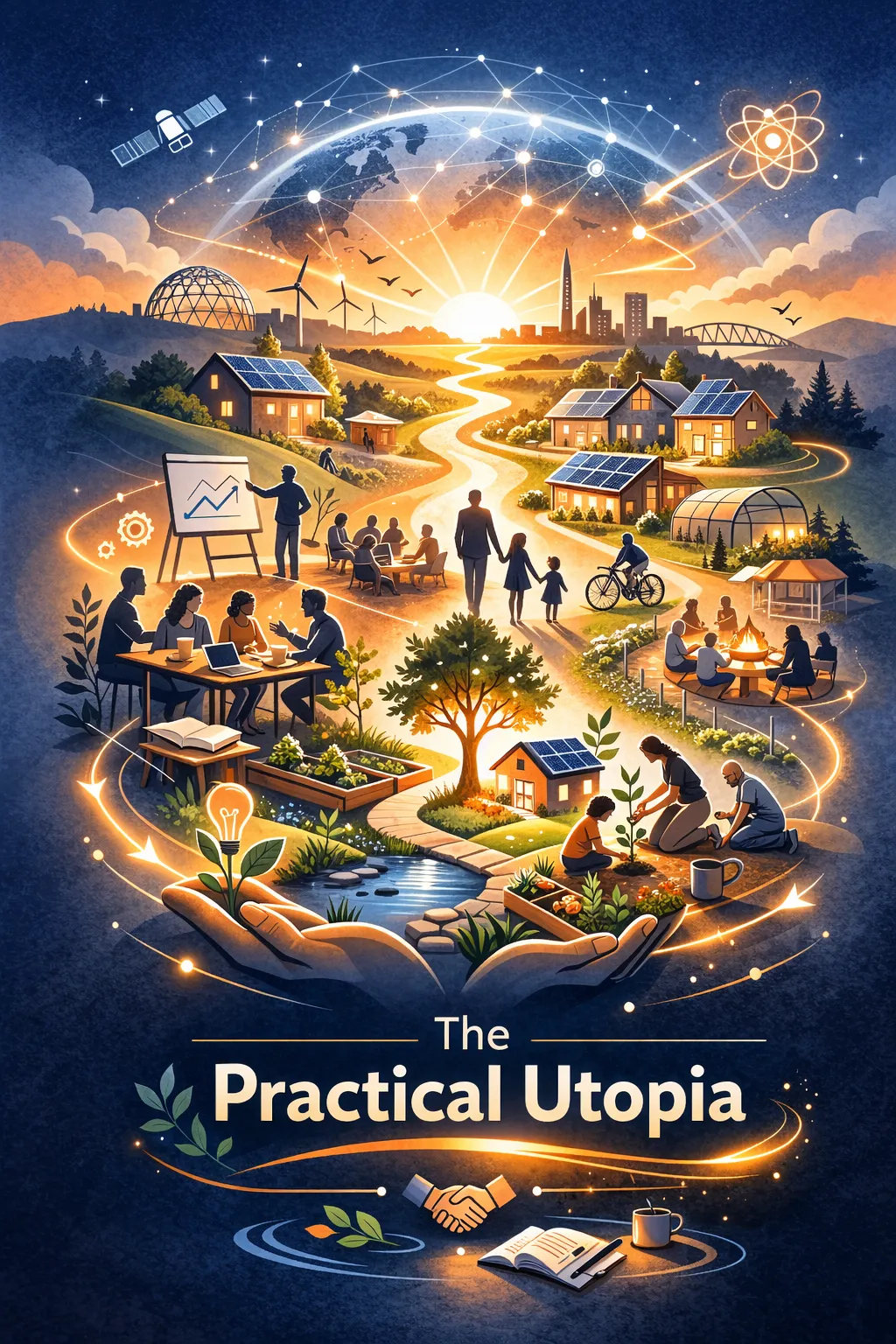
The Practical Utopia
Some ideas are not built in public first.
They begin quietly — as questions.
What would it look like if business, education, and community were not separate spheres, but part of the same ecosystem?
What if regeneration wasn’t reactive funding — but structured collaboration?
The Practical Utopia is my long-view framework for that possibility.
The Core Idea
The Practical Utopia begins with a simple premise:
Sustainable change happens when economic, educational, and social systems are designed to support one another — intentionally.
Not through slogans.
Not through temporary initiatives.
But through alignment.
When incentives connect.
When institutions collaborate.
When local capability compounds over time.
It is utopian in aspiration — and practical in structure.
The Structural Vision
The model imagines clustered networks of:
Social enterprises
Small and medium businesses
Educational institutions
Community organisations
Public sector agencies
Working in deliberate partnership rather than parallel isolation.
Each strengthening the others.
Each creating shared resilience.
Each investing in long-term regeneration.
Not abstract idealism.
Architectural intention.
Three Foundational Aims
The Practical Utopia moves toward three interconnected aims:
1. Build Collaborative Clusters
Create interconnected ecosystems of enterprise and community organisations that support and service one another.
2. Expand Fair & Flexible Opportunity
Design pathways into education, skill development, and meaningful employment — particularly for those historically excluded.
3. Raise Aspiration Through Curiosity
Use science, technology, and forward-thinking ideas to ignite confidence, engagement, and lifelong learning.
It is this third aim that directly connects to the Far Horizon Project.
A Living Framework
The Practical Utopia is not a manifesto.
It is a working hypothesis.
An evolving model.
A long-term ambition.
A structure that can be tested, refined, and built in stages.
For those interested in deeper detail, supporting papers and working models explore the concept further.
Copyright © 2026 DarrenInform