

The Rise and Fall of Atari Computers! Vision, rivalry, and a future that almost was.
- Dec 31, 2025
- 3 min read
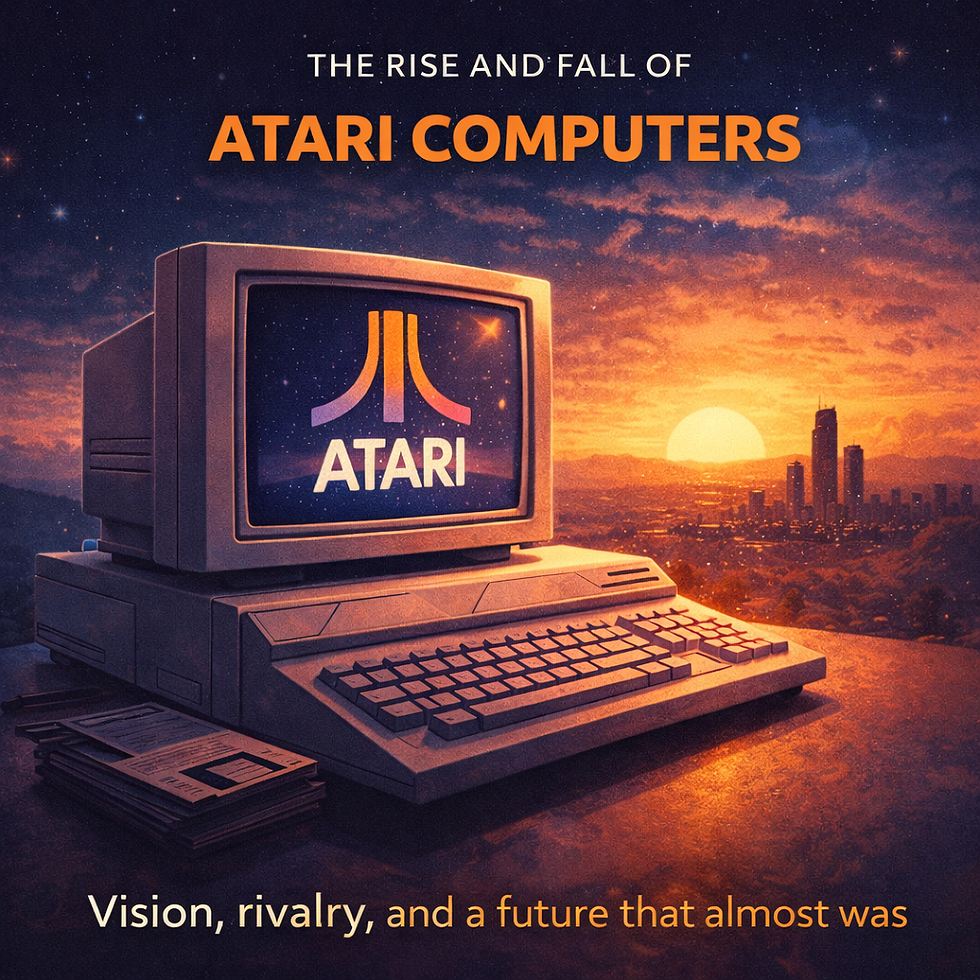
For many people, the name Atari instantly conjures up images of joysticks, blocky spaceships, and the unmistakable blip of early video games. But beyond the arcades and consoles lies a lesser-told story: Atari as a serious computer company — bold, innovative, and tragically outpaced by events beyond its control.
This is the story of how Atari helped shape home computing… and why it ultimately lost the race.
The Birth of Atari: Big Ideas, Early Success
Atari was founded in 1972 by Nolan Bushnell and Ted Dabney, initially as an arcade game company. Their breakthrough came with Pong, a deceptively simple game that became a cultural phenomenon and helped ignite the video game industry itself.
Bushnell was not just building games — he was chasing a bigger vision. He believed interactive entertainment would become a defining medium of modern life. As he once put it:
“The best ideas lose their owners and take on lives of their own.”
That idea-driven, slightly chaotic energy defined Atari’s early years. It also made the company immensely valuable — and attractive to corporate buyers.
From Arcades to Living Rooms
In 1976, Warner Communications acquired Atari, seeing enormous potential in this rapidly growing industry. With Warner’s backing, Atari expanded aggressively into home entertainment and, eventually, home computing.
By the late 1970s and early 1980s, Atari computers like the Atari 400 and Atari 800 were making waves. They offered impressive graphics and sound compared to rivals, and they appealed to hobbyists, gamers, and technologists alike.
Atari wasn’t just entering the home computer market — it was trying to redefine what a home computer could be.
The Crash and the Split
Then came the infamous video game crash of 1983.
Market saturation, poor-quality software, and overconfidence caused the industry to implode almost overnight. Atari, once the brightest star in gaming, found itself in deep trouble. Warner Communications, facing heavy losses, decided to sell.
In 1984, Jack Tramiel, founder of Commodore and a man known for his ruthless business instincts, purchased Atari’s consumer division. The company was split in two:
Atari Corporation (Tramiel): home computers and consoles
Atari Games, Inc.: arcade games (later partnered with Namco)
A pundit later summed it up perfectly:
“Atari was like a shooting star that burned too bright, too fast.”
Jack Tramiel and the Atari ST
Jack Tramiel was a Holocaust survivor, a fierce competitor, and famously blunt. His philosophy was simple:
“Business is war.”
After leaving Commodore under acrimonious circumstances, Tramiel was determined to beat his former company. His weapon of choice was the Atari ST, released in 1985.
Powered by the Motorola 68000 CPU, the ST was fast, affordable, and ahead of its time. It featured:
A graphical user interface
Built-in MIDI ports (making it hugely popular with musicians)
Strong performance at a competitive price
For a while, Atari looked like it had found its second wind.
Ahead of the Curve… Again
Throughout the late 1980s and early 1990s, Atari continued to innovate:
Mega ST (1987): aimed at professionals
Atari TT (1990): high-end performance and advanced graphics
Atari Falcon (1992): DSP chip, multimedia focus, enormous potential
The problem wasn’t technology. The problem was timing, scale, and ecosystem.
The Rise of WINTEL and Atari’s Decline
As Atari pushed forward, a different force was quietly consolidating power: WINTEL — the combination of Microsoft Windows and Intel processors.
Businesses standardised on IBM-compatible PCs. Software developers followed. Support networks grew. Economies of scale kicked in.
For home users, the choice became obvious: buy what work uses.
Despite being innovative, affordable, and beloved by enthusiasts, Atari simply couldn’t compete with the sheer momentum of the WINTEL ecosystem. Marketing muscle, compatibility, and third-party support mattered more than elegance or clever engineering.
By the mid-1990s, the writing was on the wall.
In 1996, Jack Tramiel sold Atari Corporation to JTS Corporation, effectively ending Atari’s role as a computer manufacturer.
The Legacy Lives On
Atari never truly disappeared. The brand still exists today under Atari SA, now focused on games, licensing, and retro-inspired hardware like the Atari 2600+.
But Atari computers occupy a special place in tech history — a reminder that being right, early, and brilliant doesn’t always guarantee success.
They represent an alternative future of computing: creative, multimedia-driven, and human-focused.
And for many of us, they remain unforgettable.
Final Thought
Atari’s story isn’t about failure. It’s about vision colliding with reality — and how markets don’t always reward the best ideas, only the most scalable ones.
If you owned an Atari, used one, or simply admired them from afar, you weren’t just using a computer.
You were glimpsing a future that almost happened.
Next week, we'll follow up with a look at how the lesson of Atari is applicable to the AI developments of today.


Comments